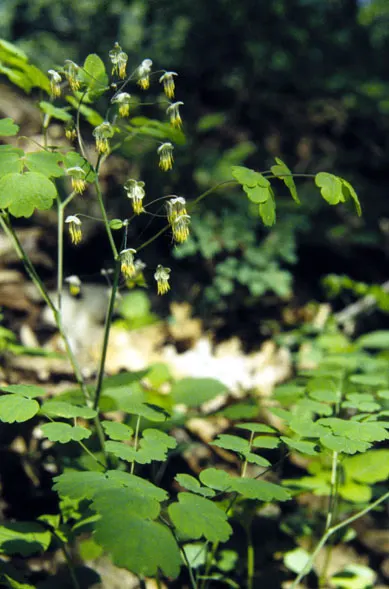
Photo: Public domain (via Wikimedia Commons)
Early Meadow Rue
Thalictrum dioicum
Also known as Quicksilver Weed, Early Meadow-rue
Key benefits
✦Traditional uses
✦Early Meadow Rue unfurls its lacy, blue-green leaves and dangling, tassel-like flowers on the forest floor before the trees overhead have even leafed out, making it one of the very first wildflowers a woodland walker meets each spring. Several Native American nations, including the Iroquois, Meskwaki, and Cherokee, knew the plant well and worked its roots into a variety of local traditions, from washes and tonics to preparations kept for particular household and ceremonial purposes. It never became a widely adopted medicinal herb the way some of its more famous relatives did, and its documented traditional uses are varied, regionally specific, and not well standardized. Today it is treasured far more as an early messenger of spring in the shade garden than as a working herb.
How to grow & use it
✦The full apothecary for Early Meadow Rue
Traditional remedies and step-by-step preparations, a complete growing guide, and how to harvest, dry, and store it, all unlocked with HerbLens Unlimited.
- ✦Remedies & preparations
- ✦ Growing guide
- ✦Harvest & storage
From under $6 a month. Free plant identifications always included.
- ✦Wild Ginger
- ✦Bloodroot
- ✦Trillium
- ✦Rue Anemone (Thalictrum thalictroides)
- ✦Tall Meadow Rue (Thalictrum pubescens)
“For the hush of a woodland floor waking up, lacy and green, weeks before anything else dares to bloom.”
Early Meadow Rue is dioecious, meaning individual plants are either male or female, and neither sex bothers with showy petals. What look like little greenish-yellow tassels are actually clusters of dangling stamens, built to release pollen on the breeze rather than to attract passing bees.
Early meadow rue is not an established medicinal herb and has not been well studied for safety. Its root and foliage should not be eaten or used as a home remedy, and it should be kept away from children and pets and avoided entirely in pregnancy and breastfeeding. Young foliage in this family can resemble other woodland plants that are genuinely toxic, so take care with identification in the wild.