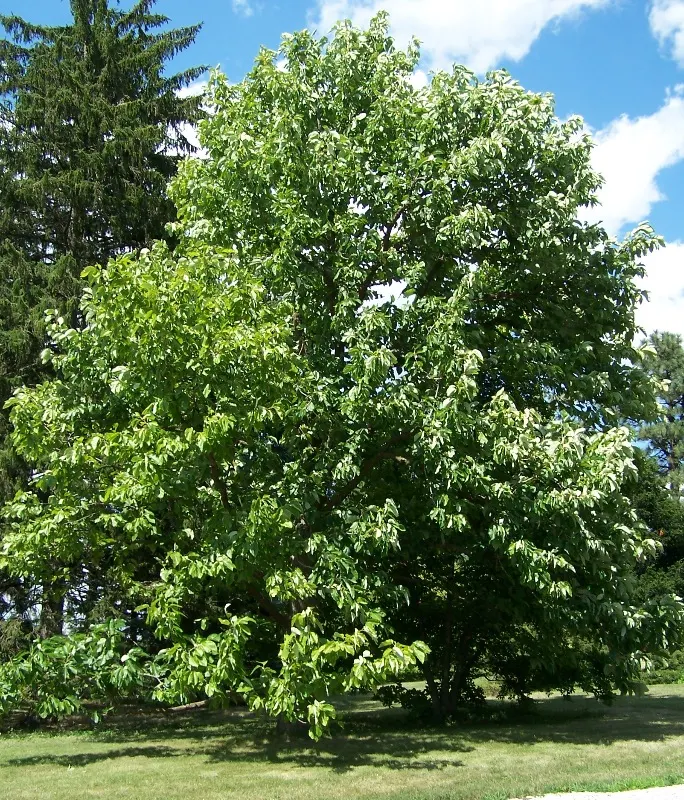
Photo: Bruce Marlin, CC BY 3.0 (via Wikimedia Commons)
Cucumbertree Magnolia
Magnolia acuminata
Also known as Cucumber Tree, Cucumber Magnolia, Blue Magnolia, Mountain Magnolia
Key benefits
✦Traditional uses
✦Long before it was prized as a shade tree, Appalachian settlers and Cherokee healers turned to the inner bark of the cucumbertree as a bitter tonic, steeping it to settle the stomach and to help the body along during chills and aching fevers. The tree takes its common name from its odd, knobby young seed pods, which dangle like small green cucumbers before ripening to rosy red in autumn. Because it grows tall and true with fine, even-grained wood, it was also valued by mountain carpenters, but it is the bark, quietly bitter and aromatic, that carried its old reputation as a household remedy. George Washington himself is said to have planted a cucumbertree at Mount Vernon, a nod to how familiar and well loved this quiet giant once was.
How to grow & use it
✦The full apothecary for Cucumbertree Magnolia
Traditional remedies and step-by-step preparations, a complete growing guide, and how to harvest, dry, and store it, all unlocked with HerbLens Unlimited.
- ✦Remedies & preparations
- ✦ Growing guide
- ✦Harvest & storage
From under $6 a month. Free plant identifications always included.
- ✦Sassafras
- ✦Wild cherry bark
- ✦Boneset
- ✦Magnolia officinalis bark
- ✦Angelica root
“For the gardener who wants a towering, storied native tree, and the herbalist drawn to a quiet, old-fashioned bitter with mountain roots.”
The cucumbertree is the largest and most cold-hardy magnolia native to North America, able to survive winters far colder than its showier southern cousins, which is why it quietly grows as far north as Ontario and New York.
No significant toxicity has been documented, but the bark contains aromatic compounds that haven't been well studied for interactions with sedatives or blood-thinning medication. Bark should never be stripped in quantity from a living tree since this can kill it.