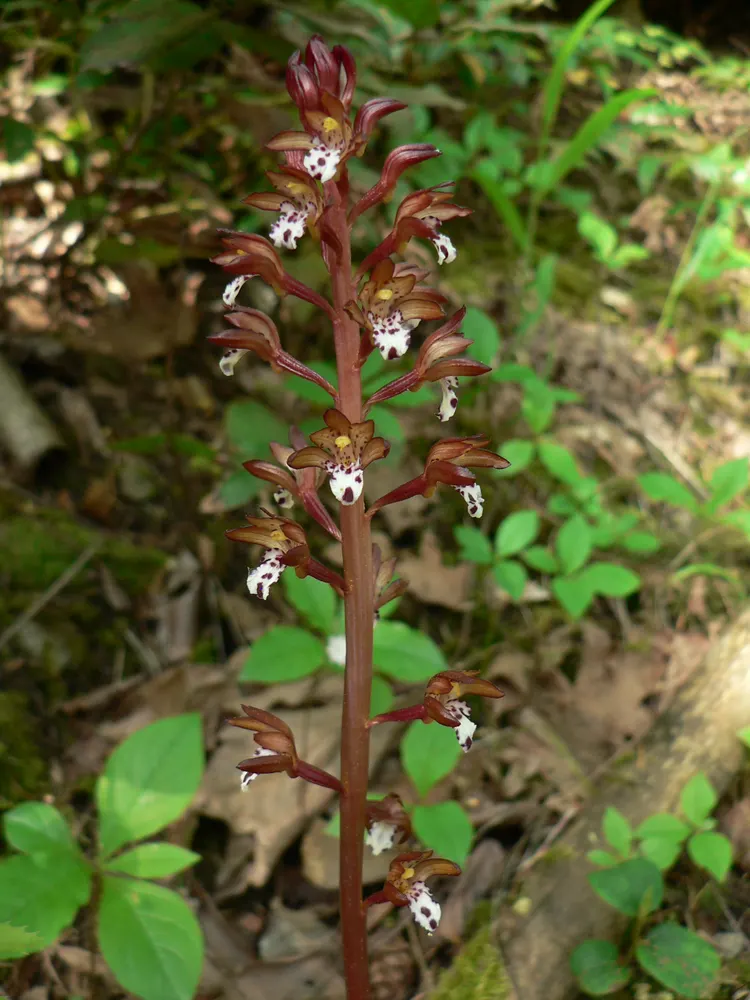
Photo: Walter Siegmund, CC BY 2.5 (via Wikimedia Commons)
Spotted Coralroot
Corallorhiza maculata
Also known as Summer Coralroot, Fever Root, Coral Root
Key benefits
✦Traditional uses
✦Spotted coralroot has no roots at all in the usual sense. Its tangled, coral-like underground stem lives in quiet partnership with forest fungi, drawing its nourishment from them rather than from sunlight, which is why the plant never bothers to grow leaves. Some Native American communities took note of its odd, ghostly presence in the woods and are recorded to have used parts of the plant in folk remedies for fevers, colds, and skin sores, and it carried the old common name fever root in a few regions. That history is thin and inconsistently documented, though, and coralroot never became part of the working herbalist's toolkit the way better known woodland plants did. Today it is best appreciated as a small marvel of the forest floor rather than as a household remedy.
How to grow & use it
✦The full apothecary for Spotted Coralroot
Traditional remedies and step-by-step preparations, a complete growing guide, and how to harvest, dry, and store it, all unlocked with HerbLens Unlimited.
- ✦Remedies & preparations
- ✦ Growing guide
- ✦Harvest & storage
From under $6 a month. Free plant identifications always included.
“For the hush of the forest floor and the wonder of a plant that lives entirely on trust, not for the medicine chest.”
Spotted coralroot has no green leaves and never photosynthesizes a day in its life. It survives entirely by tapping into underground fungal networks that also connect to the roots of nearby trees, quietly siphoning sugars the trees made in sunlight it never touches.
Spotted coralroot has no history of food or medicine use and reliable safety data doesn't exist, so it isn't eaten. It also depends on an underground fungal partnership to survive, so digging it up kills the plant.