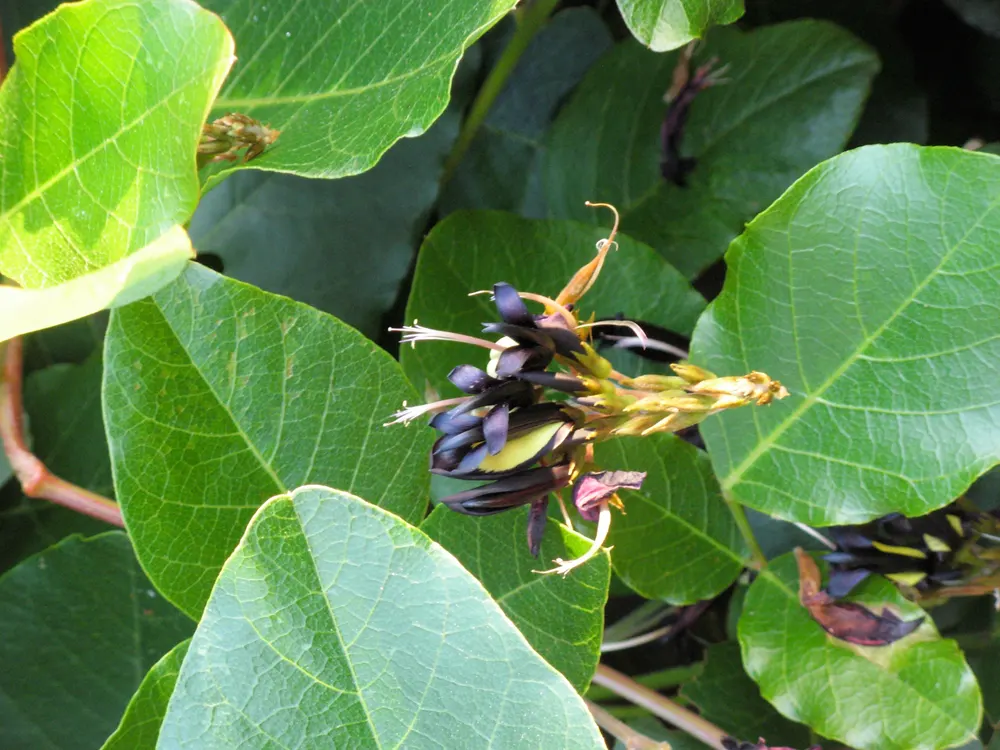
Photo: User:JarrahTree, CC BY 2.5 au (via Wikimedia Commons)
Black Coral Pea
Kennedia nigricans
Also known as Black Bean, Black Kennedia, Coral Vine
Key benefits
✦Traditional uses
✦Kennedia nigricans has no established history as a medicinal or culinary herb. Its story belongs to the garden rather than the apothecary shelf, it was gathered from the wild bushland of Western Australia and brought into cultivation for the sheer vigor of its growth and the striking near-black, yellow-throated flowers that studded its vines each spring. Honeyeaters and other nectar-feeding birds have long been drawn to those blooms, and gardeners in turn have leaned on the plant for exactly what it does best, throwing a thick green curtain over a bare fence or a crumbling bank in a single season. In its native range it also plays a quiet ecological role, resprouting readily after bushfire and helping stabilize disturbed sandy ground.
How to grow & use it
✦The full apothecary for Black Coral Pea
Traditional remedies and step-by-step preparations, a complete growing guide, and how to harvest, dry, and store it, all unlocked with HerbLens Unlimited.
- ✦Remedies & preparations
- ✦ Growing guide
- ✦Harvest & storage
From under $6 a month. Free plant identifications always included.
- ✦Hardenbergia violacea (native lilac)
- ✦Grevillea species
- ✦Other Kennedia species like the dusky coral pea
- ✦Kennedia rubicunda (dusky coral pea)
- ✦Hardenbergia violacea
“For a bare fence that needs vanishing beneath green, a bank that needs anchoring, and honeyeaters that need a reason to stay.”
The genus Kennedia honors John Kennedy, an 18th century London nurseryman whose firm helped introduce many Australian plants to European gardens, while the species name nigricans simply means blackish, a nod to the deep, almost coal-colored flowers streaked with yellow-green.
Black coral pea is grown as an ornamental with no history of safe internal use; keep its seeds and pods away from children and pets.