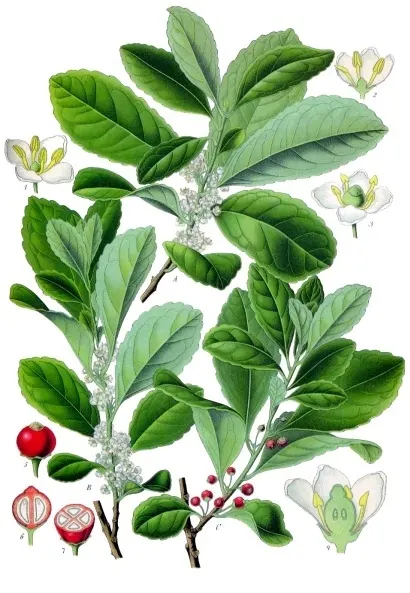
Photo: Franz Eugen Köhler, Köhler's Medizinal-Pflanzen, Public domain (via Wikimedia Commons)
Yerba Mate
Ilex paraguariensis
Also known as Mate, Paraguay Tea, Yerba, Erva-Mate, Caá
Key benefits
✦Traditional uses
✦Long before it filled gourds across South America, yerba mate was cultivated and cherished by the Guaraní people, who called it caá, simply, the plant. They roasted and steeped the leaves as both a daily nourishment and a social glue, a drink meant to be shared rather than sipped alone. Jesuit missionaries who settled in the region in the 1600s took to the practice so thoroughly that mate plantations spread across the missions, and the habit of passing a single gourd and bombilla from hand to hand became a ritual of hospitality that endures today. In traditional use, mate was valued as a tonic for weariness, sluggish digestion, and the long hours of work in the field.
How to grow & use it
✦The full apothecary for Yerba Mate
Traditional remedies and step-by-step preparations, a complete growing guide, and how to harvest, dry, and store it, all unlocked with HerbLens Unlimited.
- ✦Remedies & preparations
- ✦ Growing guide
- ✦Harvest & storage
From under $6 a month. Free plant identifications always included.
- ✦Orange peel
- ✦Mint
- ✦Cinnamon
- ✦Green tea
- ✦Guayusa
Yerba mate belongs to the holly genus, Ilex, the very same genus as the English holly wreathed on doors at Christmas, making it one of only a handful of holly species people actually drink.
Yerba mate's caffeine can cause jitteriness or a racing heart in excess and may interact with stimulant, MAOI, or blood pressure medications. Drinking it scalding hot, as is traditional in some regions, has been linked to a higher long-term risk of esophageal irritation, so let it cool a bit first.