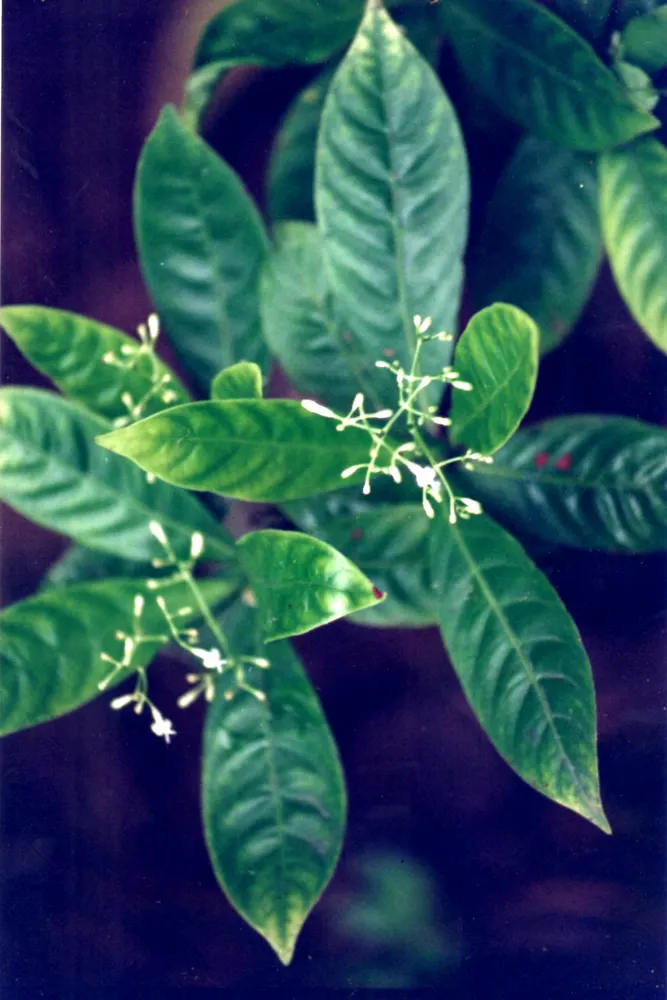
Photo: Pisofrix, CC BY-SA 4.0 (via Wikimedia Commons)
Chacruna
Psychotria viridis
Also known as Chacrona, Chacruna Verde, Amiruca, "Reina" (the queen)
Traditional uses
✦Chacruna has been grown for generations in garden plots around Amazonian villages, tended carefully by families who often keep a favored bush going for decades. Its leaves are the classic admixture added to the ayahuasca brew alongside the vine Banisteriopsis caapi, a pairing used in ceremonial and healing traditions among Shipibo-Conibo, Ashaninka, and many other Indigenous peoples of the Peruvian and Brazilian Amazon. Practitioners sometimes refer to the vine as the plant's masculine counterpart and to chacruna herself as the one who carries the vision, a reflection of how central this small shrub is to the ceremony even though it is never used alone. Because of the powerful compounds it contains, chacruna sits outside the tradition of everyday home herbalism and belongs instead to a specific, guided ceremonial lineage.
How to grow & use it
✦The full apothecary for Chacruna
Traditional remedies and step-by-step preparations, a complete growing guide, and how to harvest, dry, and store it, all unlocked with HerbLens Unlimited.
- ✦Remedies & preparations
- ✦ Growing guide
- ✦Harvest & storage
From under $6 a month. Free plant identifications always included.
“A plant known not for the kitchen or the home medicine cabinet, but for its singular, specific role in Amazonian ceremonial tradition.”
Chewed or brewed on its own, chacruna's leaves do almost nothing, because an enzyme in the human gut breaks down its main compound before it can take effect. It is only the co-brewing with Banisteriopsis caapi, which temporarily holds that enzyme in check, that lets the two plants work together. Indigenous Amazonian healers worked out this precise plant pairing long before Western science understood why it worked.
Psychotria viridis leaves contain N,N-dimethyltryptamine (DMT), a powerful psychoactive tryptamine. In the United States, DMT is a Schedule I controlled substance, and it is regulated or prohibited in many other countries as well, so preparing or ingesting material from this plant is illegal in most places outside of narrow religious, ceremonial, or research exemptions. Even where use is legally protected, it carries serious risks: unpredictable and intense psychological effects, potentially dangerous interactions with SSRIs, MAOIs, and other medications, and added risk for anyone with cardiovascular conditions, psychiatric conditions, or who is pregnant or nursing. This entry is offered for botanical and historical interest only. It is not a home-apothecary herb, there are no safe self-prepared doses to describe, and this content is not an endorsement or instruction to use it. Anyone with questions about this plant, its legal status where they live, or its ceremonial context should speak with a qualified legal or medical professional rather than relying on a home preparation.