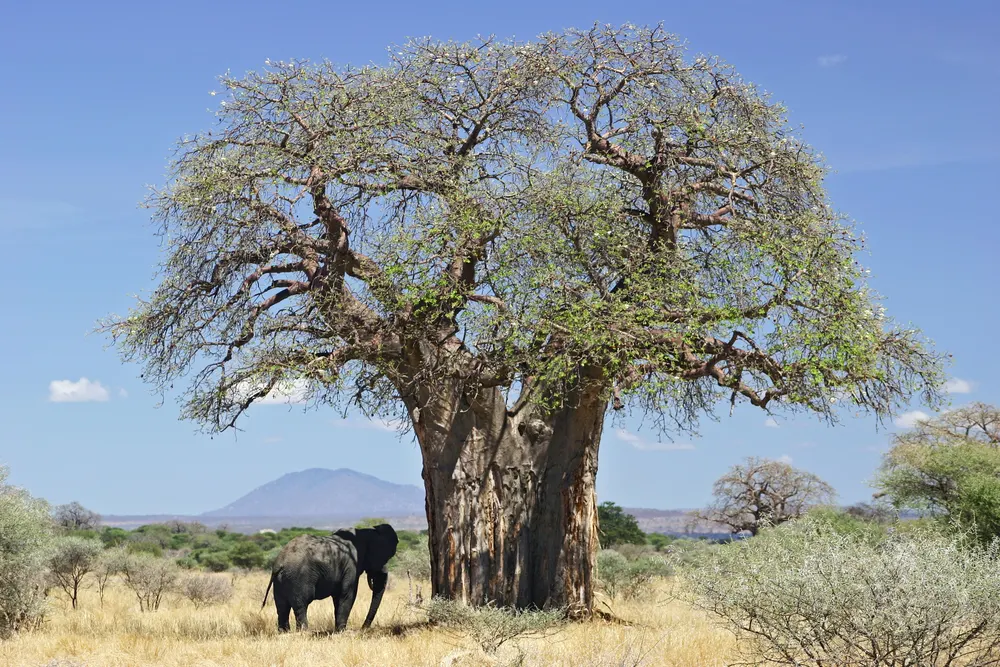
Photo: Ferdinand Reus from Arnhem, Holland, CC BY-SA 2.0 (via Wikimedia Commons)
Baobab
Adansonia digitata
Also known as African Baobab, Monkey Bread Tree, Tree of Life, Upside-Down Tree
Key benefits
✦Traditional uses
✦Long before baobab pulp appeared in smoothie bowls, it was a cornerstone of daily life across the African savanna, where the tree's shade sheltered village gatherings and its hollowed trunk sometimes served as a well, a storehouse, or even a meeting hall. The tart, powdery pulp inside the gourd-like fruit was traditionally stirred into water or porridge as a nourishing food and used to help settle the stomach, while the leaves were cooked as a leafy green and valued as a tonic during the lean, dry months. Healers across many African cultures traditionally turned to the bark, leaves, and fruit to help ease fevers and coughs, and the tree's ability to store water through drought made it a living symbol of endurance and providence. Its nickname, the Tree of Life, was not poetic exaggeration but a plain description of how many communities and animals depended on it to survive the dry season.
How to grow & use it
✦The full apothecary for Baobab
Traditional remedies and step-by-step preparations, a complete growing guide, and how to harvest, dry, and store it, all unlocked with HerbLens Unlimited.
- ✦Remedies & preparations
- ✦ Growing guide
- ✦Harvest & storage
From under $6 a month. Free plant identifications always included.
- ✦Hibiscus
- ✦Ginger
- ✦Moringa
- ✦Amla (Indian gooseberry)
- ✦Acerola cherry
“For the tang of the savanna and the patience of a thousand years, reach for baobab.”
A baobab trunk can hollow out naturally with age while the tree keeps living and growing, and some of these ancient hollows have been used over the centuries as chapels, jail cells, bus stops, and even a pub.
Baobab fruit pulp is a safe, nutritious food; eating a lot at once may cause mild digestive upset from its high fiber content.