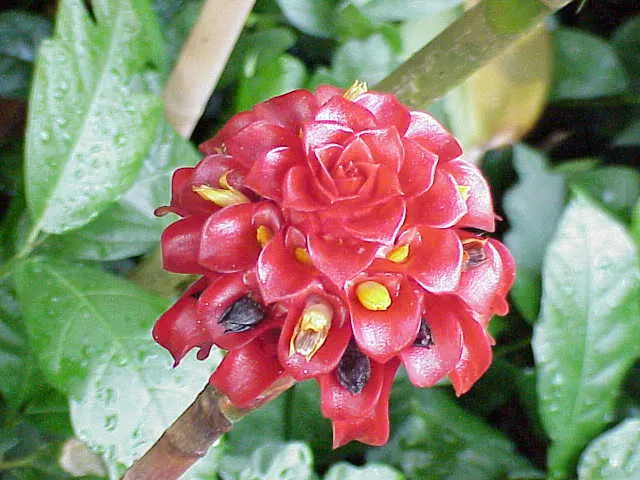
Photo: Kurt Stüber [1], CC BY-SA 3.0 (via Wikimedia Commons)
Indonesian Wax Ginger
Tapeinochilos ananassae
Also known as Pineapple Ginger, Native Ginger, Wax Ginger, Cone Ginger
Key benefits
✦Traditional uses
✦In the rainforests of tropical Queensland and New Guinea, this cane-forming relative of true ginger has long been a familiar sight along creek banks and forest edges, its glowing red cone unmistakable against the green understory. Aboriginal communities in its native range are known to have chewed the moist inner pith of the young canes to relieve thirst on long walks through the bush, much as one might suck on a piece of sugarcane. The tender growing shoots, cut low and peeled back to the pale core, have also served as an occasional bush vegetable, cooked or eaten raw in the way that other gingers and their kin have long fed forest travelers. The plant's fruit and seed heads are prized by cassowaries, and in gardens the same fiery cone that once caught a forager's eye now catches a florist's.
How to grow & use it
✦The full apothecary for Indonesian Wax Ginger
Traditional remedies and step-by-step preparations, a complete growing guide, and how to harvest, dry, and store it, all unlocked with HerbLens Unlimited.
- ✦Remedies & preparations
- ✦ Growing guide
- ✦Harvest & storage
From under $6 a month. Free plant identifications always included.
- ✦Ginger
- ✦Turmeric
- ✦Beehive ginger
- ✦Torch ginger
“For the corner of the garden that wants to look like it was lit from within, this is the plant that answers.”
The showy red 'cone' that gives this plant its charm is not actually the flower. It is a tight spiral of waxy bracts, and the true flowers are small, tubular, and yellow, poking out from between the bracts for just a day or two at a time before the cone carries on glowing red for weeks after.
No toxicity has been documented for this plant, and it is not established as a medicinal herb, though tender shoots are sometimes eaten as a bush food in its native range.