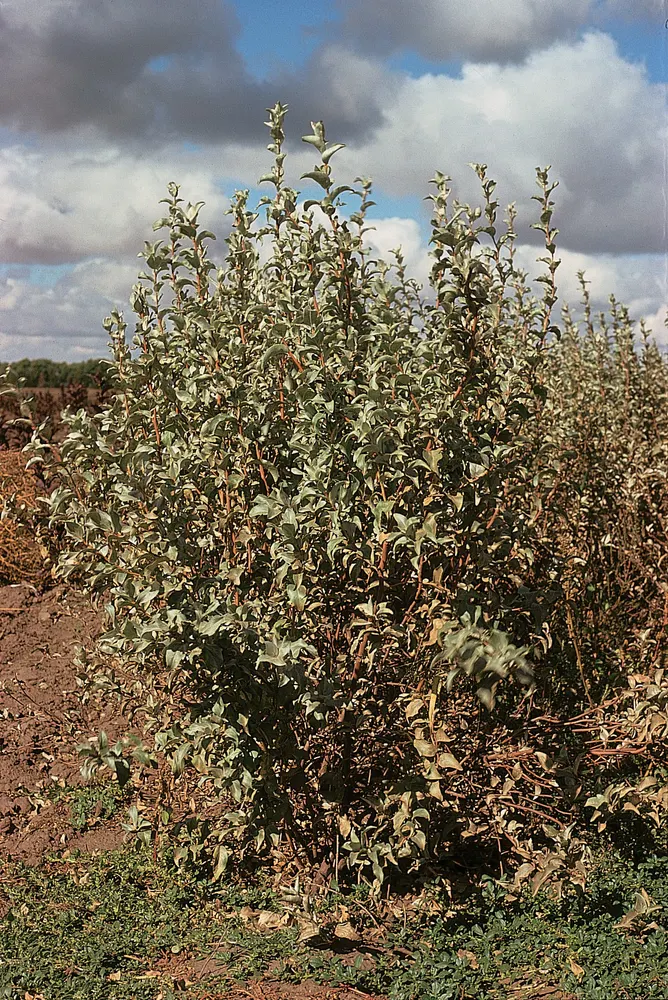
Photo: Public domain (via Wikimedia Commons)
Silverberry
Elaeagnus commutata
Also known as Silverberry, Wolf Willow, American Silverberry, Silver-leaf Oleaster
Key benefits
✦Traditional uses
✦Long before it had a Latin name, silverberry was a familiar presence to the Cree, Blackfoot, Assiniboine, and other Plains and Northern nations, who gathered its silvery berries in early autumn to eat fresh, dry for winter stores, or pound into pemmican alongside meat and fat. Its scent mattered as much as its fruit. The small yellow flowers perfume entire river bottoms in June, and that fragrance was prized enough that blossoms were sometimes gathered simply to scent lodges and clothing. The hard, silvery seed within each berry was polished and strung into beads and rattles, a craft still practiced today, and the fibrous inner bark was twisted into cordage strong enough for rope and snares. Some nations also turned to a bark infusion as a folk remedy for coughs and chest colds during the cold months.
How to grow & use it
✦The full apothecary for Silverberry
Traditional remedies and step-by-step preparations, a complete growing guide, and how to harvest, dry, and store it, all unlocked with HerbLens Unlimited.
- ✦Remedies & preparations
- ✦ Growing guide
- ✦Harvest & storage
From under $6 a month. Free plant identifications always included.
- ✦Rose hips
- ✦Chokecherry
- ✦Saskatoon berry
- ✦Goumi berry (Elaeagnus multiflora)
- ✦Autumn olive (Elaeagnus umbellata)
“When the prairie wind carries a wave of honeyed fragrance in June, and a shrub of silver leaves stands shimmering against the open sky.”
Silverberry seeds are so hard and lustrous once polished that they were traditionally strung into necklaces, earrings, and ceremonial rattles, giving the shrub a second life as jewelry long after its fruit was eaten.
The berries are edible, though raw fruit is mealy, dry, and mildly astringent, and eating a lot of underripe fruit can cause mild stomach upset, especially in children.