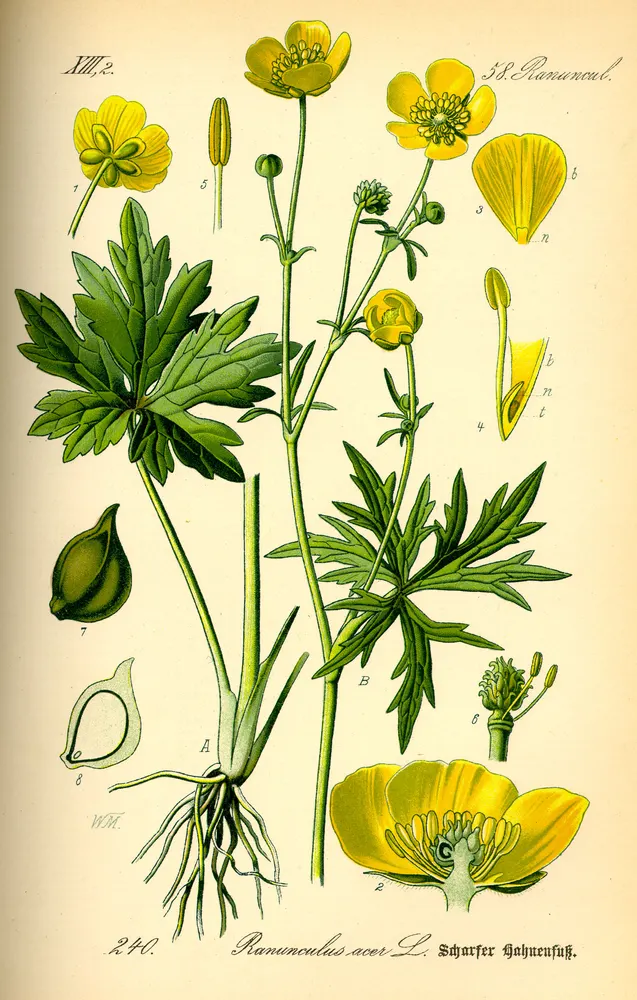
Photo: Public domain (via Wikimedia Commons)
Meadow Buttercup
Ranunculus acris
Also known as Tall Buttercup, Common Buttercup, Giant Buttercup, Tall Crowfoot
Key benefits
✦Traditional uses
✦Meadow buttercup earned a place in country memory more as a plant to be wary of than one to gather. Farmers long read a field thickening with its glossy yellow flowers as a sign of tired, overgrazed pasture, since grazing animals leave the bitter, blistering leaves untouched and the buttercup spreads freely in their place. In old English and Irish folk tradition, the crushed leaves were sometimes pressed onto the skin by beggars to deliberately raise sores and win sympathy, a grim practice that shows just how well country people understood its bite. It has never held a settled place in home herbalism the way gentler meadow plants have, and its story is really one of caution passed down through generations rather than a remedy.
How to grow & use it
✦The full apothecary for Meadow Buttercup
Traditional remedies and step-by-step preparations, a complete growing guide, and how to harvest, dry, and store it, all unlocked with HerbLens Unlimited.
- ✦Remedies & preparations
- ✦ Growing guide
- ✦Harvest & storage
From under $6 a month. Free plant identifications always included.
“For the meadow's brightest gold, best admired where it grows and never gathered.”
The glossy shine on a buttercup's petals is not ordinary pigment. Botanists have found the petals have a mirror-like layer that reflects light with unusual brilliance, the same shine behind the old countryside game of holding a buttercup under a child's chin to see if the golden glow means they love butter.
All parts of Ranunculus acris, meadow buttercup, contain protoanemonin, an acrid oil that forms when the plant's tissue is bruised, cut, or chewed. Fresh sap is a strong irritant to skin and mucous membranes, capable of causing redness, burning, and blistering within minutes of contact. If eaten, it burns the mouth and digestive tract and has caused poisoning in grazing animals, though most livestock instinctively avoid it for its bitter, acrid taste. Drying reduces some of the irritant potency but does not reliably remove it, so hay heavily laced with buttercup is still best avoided. This plant has no established safe internal or topical use in modern herbal practice, and it should not be eaten, brewed, or applied to skin or wounds. Keep it away from children, pets, and grazing animals, and wash your hands well after handling cut or bruised stems. If ingestion or a skin reaction occurs, contact a poison control center or a qualified medical professional right away.