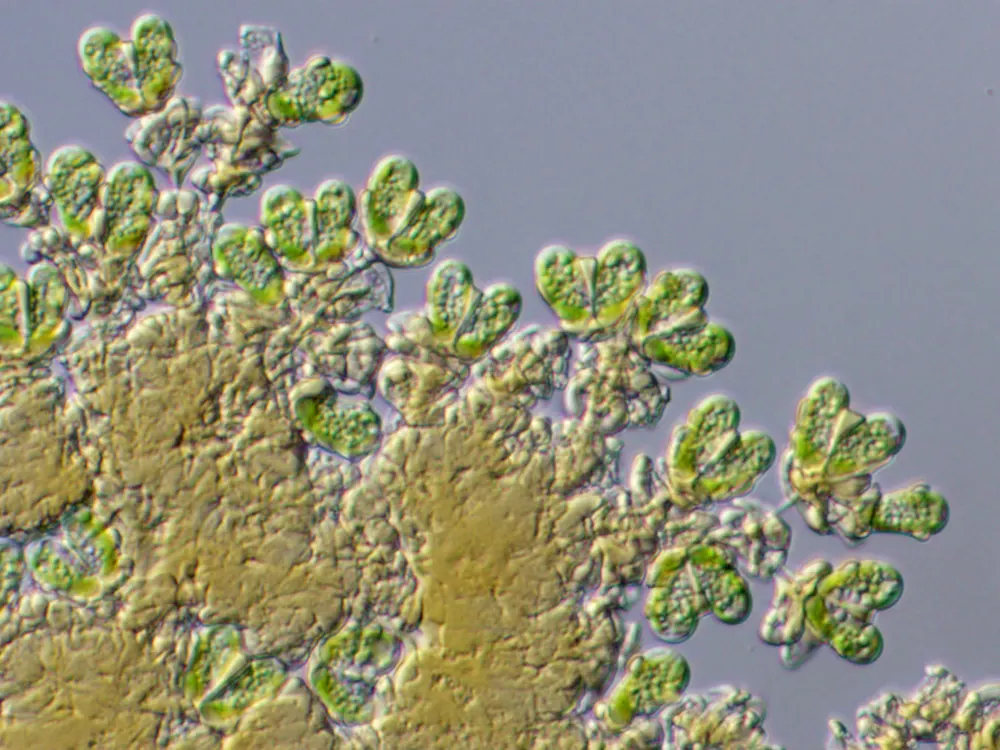
Photo: ja:User:NEON / User:NEON_ja, CC BY-SA 3.0 (via Wikimedia Commons)
Botryococcus (Boghead Algae)
Botryococcus braunii
Also known as Boghead algae, Green oil algae, B. braunii
Key benefits
✦Traditional uses
✦Botryococcus braunii has no place in traditional herbal medicine, but it holds a quiet, remarkable history all its own. This tiny green alga has been quietly at work for hundreds of millions of years, its oil-laden colonies sinking to lake and sea beds and slowly compacting into some of the world's richest oil shale and boghead coal deposits, including the coorongite found along Australia's Coorong lagoon and the torbanite mined in Scotland. In recent decades scientists have turned back to this same alga with fresh eyes, growing it in ponds and bioreactors in the hope that what nature once took eons to do underground, we might learn to do again on the surface, cleanly and quickly, as a renewable source of oil.
How to grow & use it
✦The full apothecary for Botryococcus (Boghead Algae)
Traditional remedies and step-by-step preparations, a complete growing guide, and how to harvest, dry, and store it, all unlocked with HerbLens Unlimited.
- ✦Remedies & preparations
- ✦ Growing guide
- ✦Harvest & storage
From under $6 a month. Free plant identifications always included.
- ✦Chlorella
- ✦Nannochloropsis
- ✦Scenedesmus
- ✦Chlorella vulgaris
- ✦Scenedesmus
“Not a remedy to reach for, but a reminder that some of the earth's oldest treasures began as something impossibly small.”
Some strains of Botryococcus braunii can be up to 86 percent hydrocarbon oil by dry weight, one of the highest oil yields ever recorded in a living organism, which is why entire fields of ancient oil shale owe their existence to countless generations of this single humble alga.
This alga has no history as a food and no human safety data, so it should never be gathered and eaten. Ponds where it grows can also host toxic cyanobacteria blooms that are easily mistaken for it, so any wild pond scum is best left untouched.