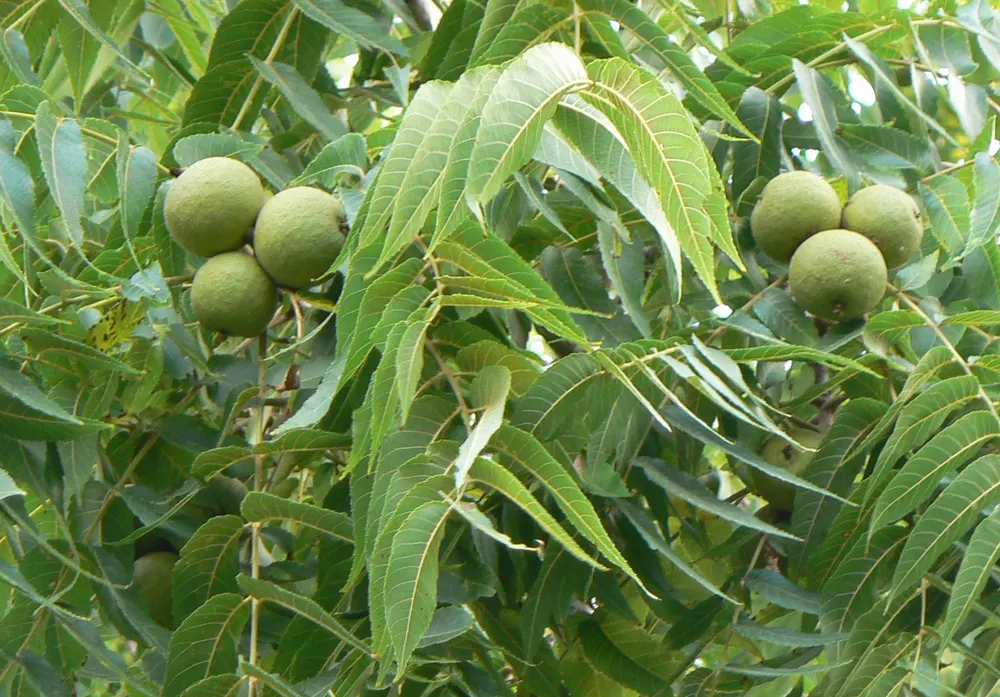
Photo: Public domain (via Wikimedia Commons)
Black Walnut
Juglans nigra
Also known as American Walnut, Eastern Black Walnut, Butternut's Cousin
Key benefits
✦Traditional uses
✦Long before it appeared in tincture bottles, black walnut was a fixture of the eastern woodland pharmacy. Cherokee and other Native peoples used preparations of the hull and bark for skin troubles and as a wash for wounds, while nineteenth century Eclectic physicians reached for the green hull to address stubborn skin eruptions and what they called 'foul' conditions of the mouth and throat. Homesteaders simmered the hulls not for medicine alone but for ink and for that deep golden brown dye that colored Confederate uniforms the color of butternut. By the time modern herbalism arrived, black walnut had already earned its reputation as the tree that stains your hands and clears your skin in the same afternoon.
How to grow & use it
✦The full apothecary for Black Walnut
Traditional remedies and step-by-step preparations, a complete growing guide, and how to harvest, dry, and store it, all unlocked with HerbLens Unlimited.
- ✦Remedies & preparations
- ✦ Growing guide
- ✦Harvest & storage
From under $6 a month. Free plant identifications always included.
- ✦Wormwood
- ✦Cloves
- ✦Calendula
- ✦Pau d'Arco
- ✦Oregon Grape Root
“For the deep, dark, old-fashioned remedy that stains your hands and remembers the forest floor.”
Black walnut roots and hulls release juglone into the surrounding soil, a natural chemical so effective at suppressing competitors that gardeners have known for two centuries never to plant tomatoes beneath one.
Black walnut hull and leaf contain tannins that can irritate skin and stain it brown for days, so patch test before topical use. Avoid it if you have a tree nut allergy, and be sure of identification when foraging, since black walnut can be confused with other trees.