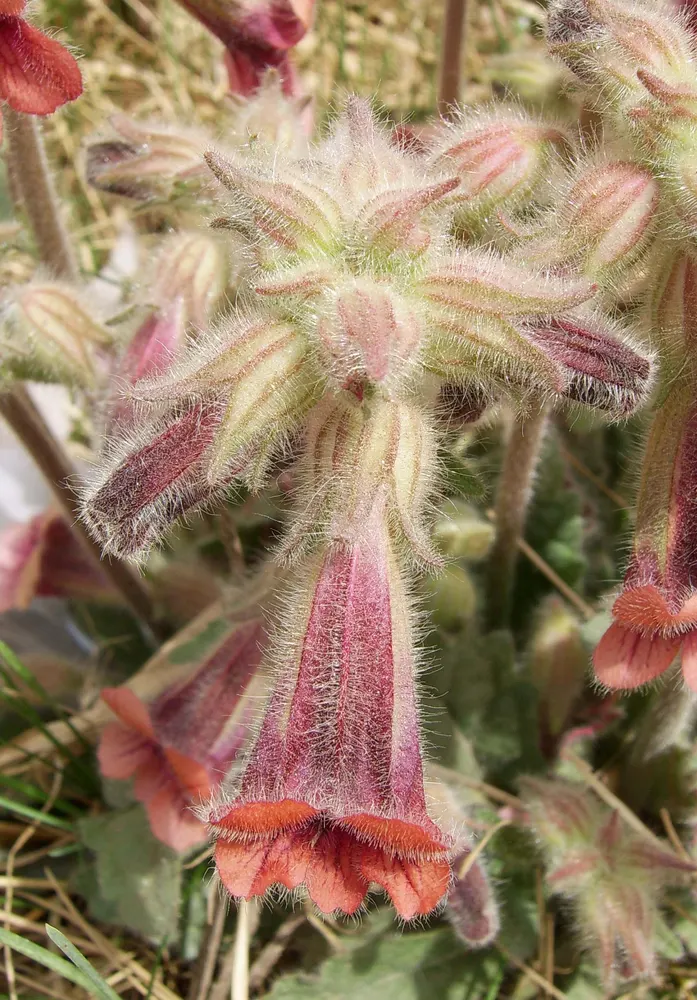
Photo: Shizhao, CC BY 2.5 (via Wikimedia Commons)
Chinese Foxglove
Rehmannia glutinosa
Also known as Rehmannia, Di Huang, Chinese Foxglove Root, Sheng Di Huang, Shu Di Huang
Key benefits
✦Traditional uses
✦Rehmannia's root, known as di huang, is one of the oldest and most trusted herbs in the Chinese materia medica, prized for centuries as a deep tonic for blood and vital essence. Used fresh, it was traditionally turned to for clearing heat and cooling the blood during fevers or restlessness. Once steamed repeatedly with rice wine and sun dried, the root darkens into shu di huang, a rich, sweet tonic traditionally given to rebuild strength after illness, steady the cycle, and ease the night sweats and low-grade fatigue associated with what practitioners called yin deficiency. It remains a cornerstone of classic formulas such as Six Flavor Rehmannia Pill and Four Substance Decoction, both still referenced in herbal practice today.
How to grow & use it
✦The full apothecary for Chinese Foxglove
Traditional remedies and step-by-step preparations, a complete growing guide, and how to harvest, dry, and store it, all unlocked with HerbLens Unlimited.
- ✦Remedies & preparations
- ✦ Growing guide
- ✦Harvest & storage
From under $6 a month. Free plant identifications always included.
- ✦Astragalus root
- ✦Goji berry (wolfberry)
- ✦Chinese angelica (dong quai)
- ✦Solomon's seal root
- ✦Fo-ti (he shou wu)
“When it is time to slow down, restore what has been depleted, and rebuild strength from the root up.”
The genus Rehmannia was named in honor of Joseph Rehmann, a German-born physician working in Russia in the early 1800s who studied the medicinal plants of China and Central Asia, though he likely never laid eyes on the living plant himself.
Rehmannia glutinosa is generally regarded as a gentle traditional tonic herb rather than a toxic one, but it is not without cautions. In Chinese medicine it is considered cooling and moistening, and taken in excess or by those with weak, damp, or easily upset digestion it has traditionally been noted to cause bloating, loose stools, or a heavy feeling in the stomach. The fresh root in particular is regarded as strongly cooling and is traditionally avoided by those who run cold or have diarrhea. Because rehmannia may influence blood sugar, anyone taking diabetes medication or blood thinners should be especially cautious, and it is not recommended during pregnancy or breastfeeding without guidance. As with any tonic herb taken over time, it is best to talk with a qualified herbalist, TCM practitioner, or healthcare provider before using it, particularly alongside other medications.