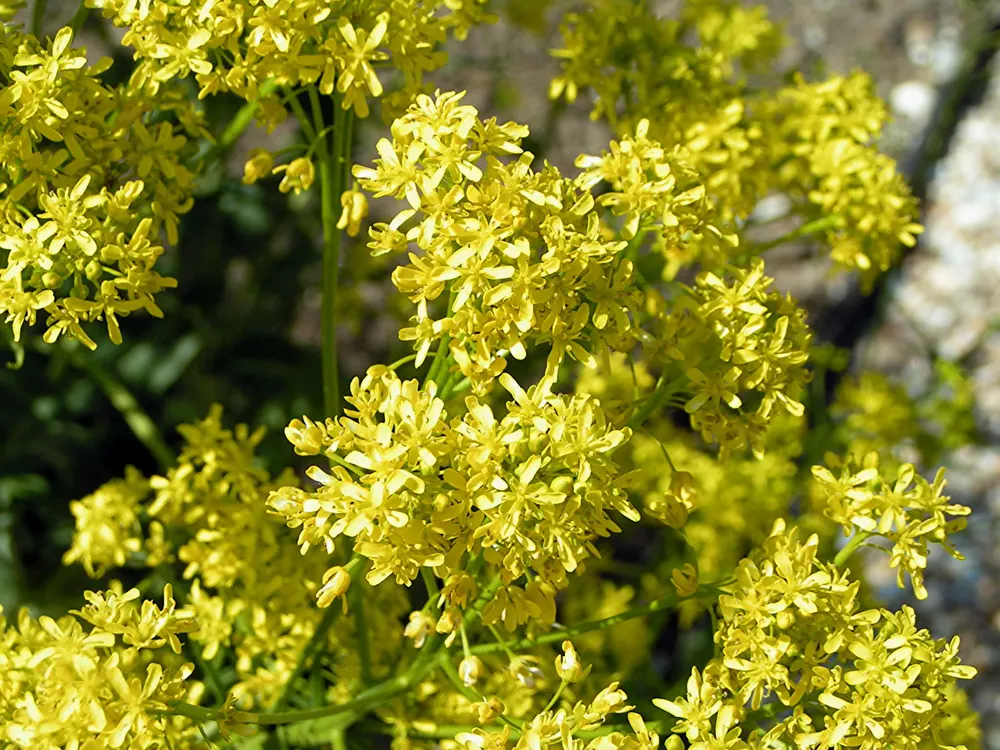
Photo: CC BY-SA 3.0 (via Wikimedia Commons)
Woad
Isatis tinctoria
Also known as Dyer's Woad, Glastum, European Woad, Ban Lan Gen (related use in Chinese herbalism)
Key benefits
✦Traditional uses
✦Long before synthetic dyes existed, woad was the great blue of the old world, the plant that colored the robes of medieval merchants and, according to Julius Caesar's own account, painted the bodies of ancient British warriors before battle. Its leaves hold a compound called indican, which turns a startling indigo blue through fermentation, and entire regions of France, Germany, and England once built their economies around dye vats full of woad. Beyond the dye pot, folk herbalists in Europe applied bruised or infused woad leaf to wounds and skin troubles, while related Isatis species have long held a place in Chinese herbal tradition as a cooling remedy taken during fevers and the cold and flu season. It is a plant with two lives, one as a working dye, one as a quiet household remedy, and both stretch back thousands of years.
How to grow & use it
✦The full apothecary for Woad
Traditional remedies and step-by-step preparations, a complete growing guide, and how to harvest, dry, and store it, all unlocked with HerbLens Unlimited.
- ✦Remedies & preparations
- ✦ Growing guide
- ✦Harvest & storage
From under $6 a month. Free plant identifications always included.
- ✦Elderflower
- ✦Calendula
- ✦Plantain
- ✦Indigo (Indigofera tinctoria) for dye work
- ✦Isatis indigotica leaf, its close botanical relative used in Chinese herbalism
“For the deep, old-world blue and the quiet cottage remedy that came long before it had a Latin name.”
According to Julius Caesar's account of his British campaigns, the ancient Britons dyed themselves blue with woad before going into battle, a detail that helped cement the plant's reputation as the color of courage for centuries afterward.
Concentrated internal use, as with indigo extracts used medicinally, has been linked to liver enzyme changes and rare liver toxicity, especially with prolonged or high-dose use. Avoid during pregnancy and breastfeeding, and use caution with liver disease.