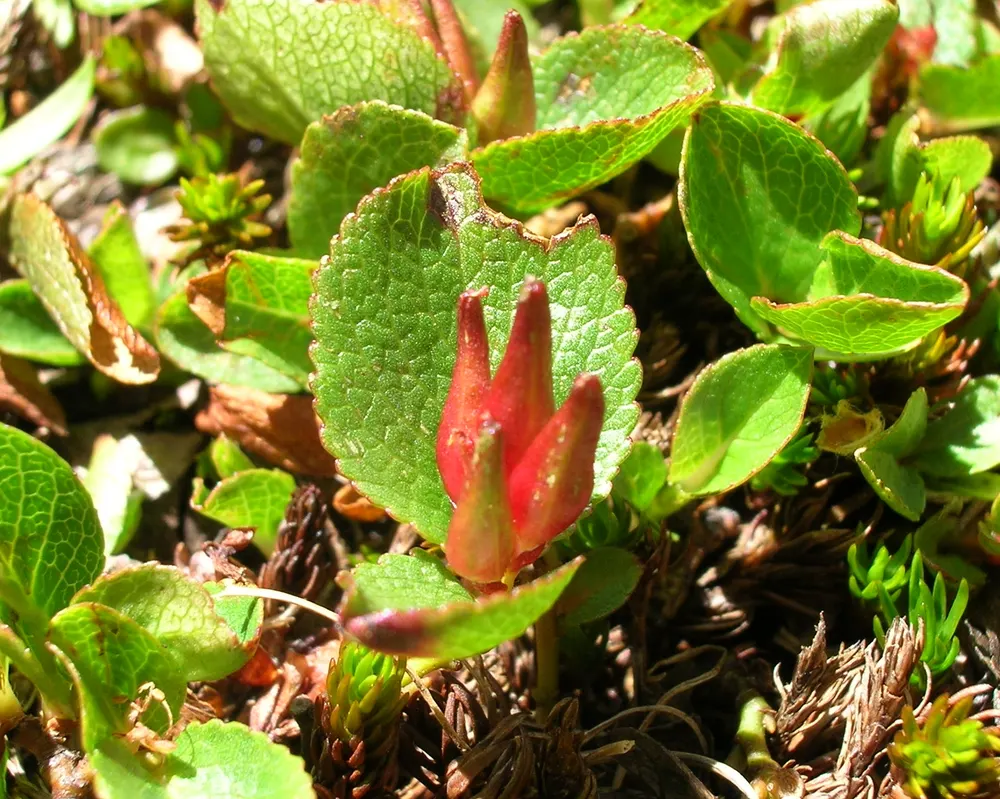
Photo: El Grafo, CC BY-SA 3.0 (via Wikimedia Commons)
Dwarf Willow
Salix herbacea
Also known as Least Willow, Snowbed Willow, Dwarf Snow Willow
Key benefits
✦Traditional uses
✦Dwarf willow belongs to the same genus as white willow, the bark long steeped for its soothing, salicin-rich properties, but this particular species has never carried that same herbal reputation. Its stems are often no thicker than a wire and its whole body may stand shorter than a matchstick, so people who lived among it, from Arctic hunters to alpine shepherds, seem to have prized it more as forage and as a marker of the coming thaw than as medicine. Its true legacy is ecological rather than medicinal, it is one of the first plants to green a snowbed as it melts, and it has long fed reindeer, ptarmigan, and other tundra animals through the short northern summer. Botanists and alpine gardeners today treasure it chiefly as a curiosity, often described as the smallest woody plant, or even the smallest tree, on earth.
How to grow & use it
✦The full apothecary for Dwarf Willow
Traditional remedies and step-by-step preparations, a complete growing guide, and how to harvest, dry, and store it, all unlocked with HerbLens Unlimited.
- ✦Remedies & preparations
- ✦ Growing guide
- ✦Harvest & storage
From under $6 a month. Free plant identifications always included.
- ✦White Willow (Salix alba) bark, the species actually associated with traditional salicin-rich willow bark preparations
“For the person who wants to stand over the smallest tree in the world and still look down.”
A mature dwarf willow can stand barely two or three inches tall, yet botanists classify it as a true tree in miniature, with its woody trunk and branches creeping sideways just beneath the soil surface so that only the leaves and catkins ever see daylight, an adaptation that lets it dodge the shredding arctic wind entirely.
Dwarf willow has no established history of herbal use, but like other willows it likely contains aspirin-related salicin compounds. It should be avoided by anyone with a salicylate allergy, on blood thinners, pregnant or nursing, or by children and teens recovering from a viral illness due to the risk of Reye's syndrome.