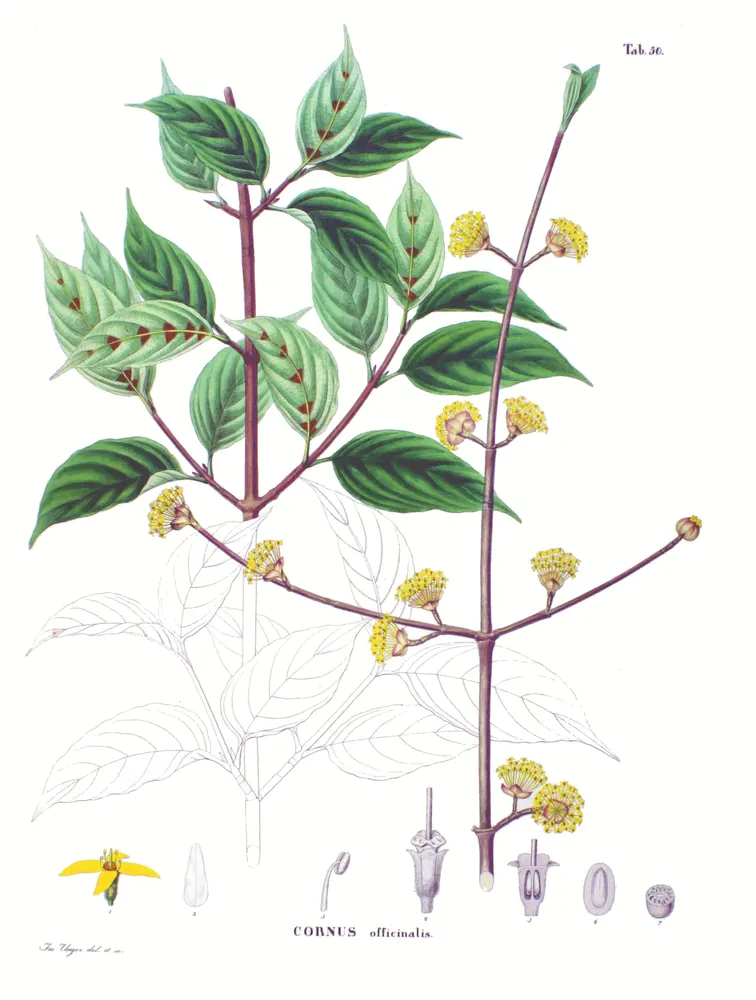
Photo: Philipp Franz von Siebold and Joseph Gerhard Zuccarini, Public domain (via Wikimedia Commons)
Cornelian Cherry
Cornus officinalis
Also known as Japanese Cornel, Asiatic Dogwood, Shan Zhu Yu, European Cornel
Key benefits
✦Traditional uses
✦Long before it found its way into European jams and cordials, the cornelian cherry was one of the most trusted fruits in East Asian medicine, where its dried, deep red drupes are known as shan zhu yu and have been used for centuries as a gentle tonic for the kidneys and liver. Practitioners of traditional Chinese medicine prized it as a foundational ingredient in formulas meant to steady the body through fatigue, aging, and the changes of midlife. In the villages of Central and Eastern Europe, the same tart little fruit was stewed into syrups and preserves, treasured as much for its bright flavor as for its reputed ability to settle the stomach and ease seasonal ailments. Two very different cultures, an ocean apart, arrived at the same fondness for this modest, glossy fruit.
How to grow & use it
✦The full apothecary for Cornelian Cherry
Traditional remedies and step-by-step preparations, a complete growing guide, and how to harvest, dry, and store it, all unlocked with HerbLens Unlimited.
- ✦Remedies & preparations
- ✦ Growing guide
- ✦Harvest & storage
From under $6 a month. Free plant identifications always included.
- ✦Goji Berry
- ✦Schisandra
- ✦Rehmannia
- ✦Rose Hip
- ✦Hawthorn Berry
“For the quiet, steady kind of nourishment that history keeps returning to.”
Cornelian cherry wood is so dense and hard that it sinks in water, and it was once favored by ancient Greeks and Romans for spear shafts, including, legend holds, the very spear Romulus is said to have thrown to mark the founding boundary of Rome.
Cornelian cherry is safe when ripe, but unripe fruit is very astringent and can upset the stomach, so let it fully soften before eating.