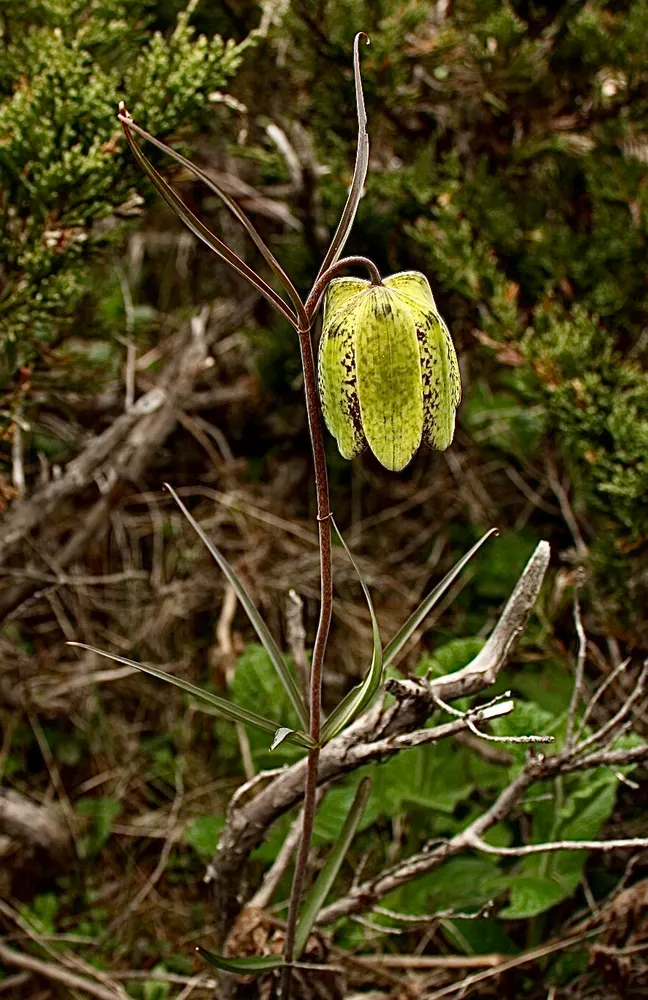
Photo: Siddarth Machado, CC BY 4.0 (via Wikimedia Commons)
Fritillary Bulb
Fritillaria cirrhosa
Also known as Chuan Bei Mu, Sichuan Fritillary, Tendril-leaved Fritillary, Bulbus Fritillariae Cirrhosae
Key benefits
✦Traditional uses
✦Known in Traditional Chinese Medicine as Chuan Bei Mu, this small alpine bulb has been prized for well over a thousand years as one of the great lung-soothing herbs, reserved traditionally for the dry, hacking, phlegm-scant coughs that other remedies could not touch. It appears in classic formulas alongside loquat leaf and apricot kernel, most famously in the beloved cough syrup Pipa Gao. Because the plant grows so slowly at such extreme altitude, true Chuan Bei Mu became one of the most expensive and sought-after materials in the whole apothecary, a mark of a formula meant to be taken seriously. Every batch traditionally passed through the hands of a processor before it ever reached a patient, never used straight from the mountainside.
How to grow & use it
✦The full apothecary for Fritillary Bulb
Traditional remedies and step-by-step preparations, a complete growing guide, and how to harvest, dry, and store it, all unlocked with HerbLens Unlimited.
- ✦Remedies & preparations
- ✦ Growing guide
- ✦Harvest & storage
From under $6 a month. Free plant identifications always included.
- ✦Loquat leaf (Pipa Ye)
- ✦Platycodon root (Jie Geng)
- ✦Apricot kernel (Xing Ren)
- ✦Fritillaria thunbergii (Zhe Bei Mu)
- ✦Fritillaria pallidiflora
“The high alpine bulb the old physicians reserved for the driest, most stubborn cough, never for the home shelf.”
The genus name Fritillaria comes from the Latin fritillus, meaning dice-box, a nod to the checkered pattern on the petals that early botanists thought resembled a rattling cup of dice.
Raw fritillary bulb contains toxic alkaloids that have caused serious poisoning, including fatal cases in children who mistook the bulb for food. In Traditional Chinese Medicine it is used only as a precisely processed ingredient in professional formulas, never as a home tea, and it is generally avoided in pregnancy.