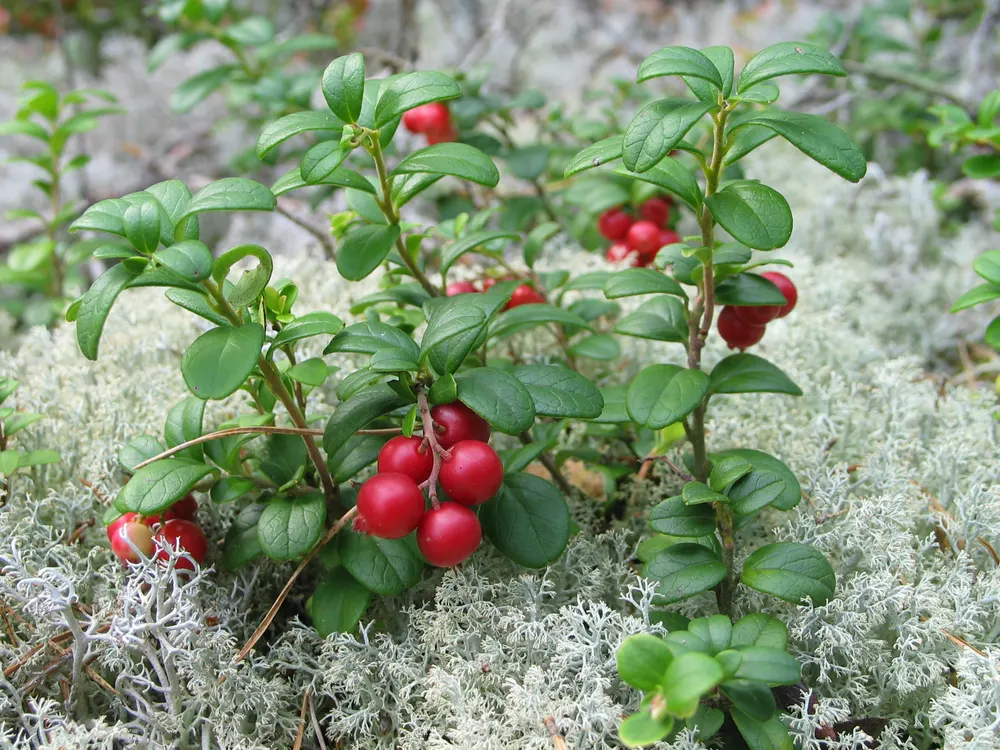
Photo: Jonas Bergsten, Public domain (via Wikimedia Commons)
Lingonberry
Vaccinium vitis-idaea
Also known as Cowberry, Mountain Cranberry, Foxberry, Partridgeberry
Key benefits
✦Traditional uses
✦For as long as there have been people in the far north, there have been lingonberries waiting for them under the snow. The Sami, Finnish, Swedish, and Russian peoples gathered these tart little berries from boreal forest floors each autumn, prizing them not just as food but as one of the few fruits that would keep through the long winter without spoiling. Because lingonberry fruit holds its own natural preservative, whole pails of berries could be stored in cold cellars in nothing more than water, a trick that fed families through months when little else grew. The leaves, closer kin to bearberry than most people realize, were traditionally steeped as a tea and used the way northern herbalists used uva ursi, to ease water infections and support the kidneys and bladder.
How to grow & use it
✦The full apothecary for Lingonberry
Traditional remedies and step-by-step preparations, a complete growing guide, and how to harvest, dry, and store it, all unlocked with HerbLens Unlimited.
- ✦Remedies & preparations
- ✦ Growing guide
- ✦Harvest & storage
From under $6 a month. Free plant identifications always included.
- ✦Bearberry (Uva Ursi)
- ✦Rosehip
- ✦Elderberry
- ✦Cranberry
- ✦Bearberry (Uva Ursi) for leaf preparations
“For the tart, ruby-red jewel of the northern forest floor, steeped into a quiet cup or spooned bright and sharp over the table.”
Lingonberries are sometimes called self-preserving fruit, because they naturally contain benzoic acid, the same compound long used to keep foods from spoiling, which is why Nordic families could store whole barrels of them in nothing but cold water all winter long.
Lingonberry fruit is a safe, everyday food. The leaf contains arbutin and was traditionally used only short-term rather than as a daily tea, so avoid prolonged or high-dose use, and skip it during pregnancy or with kidney disease.