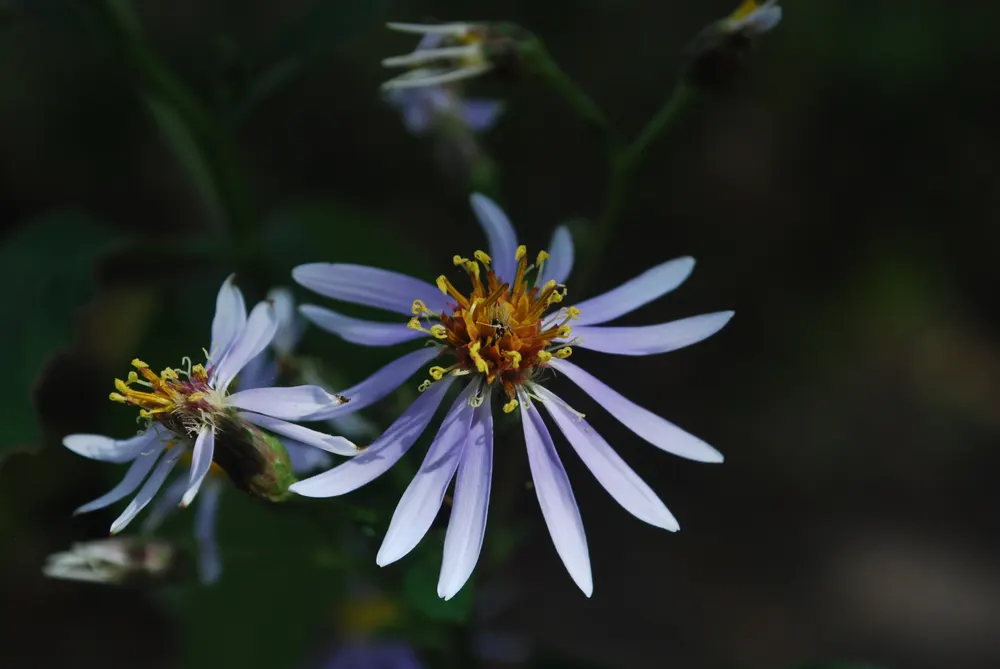
Photo: wackybadger, CC BY-SA 2.0 (via Wikimedia Commons)
Bigleaf Aster
Eurybia macrophylla
Also known as Large-leaved Aster, Big-leaved Aster, Large Leaf Aster
Key benefits
✦Traditional uses
✦Bigleaf aster is, first and foremost, a plant of the northern forest floor, one of the most familiar sights in a Great Lakes or New England woodland by late summer, when its pale lavender flowers rise above broad, heart-shaped leaves. Among the Ojibwe and other Anishinaabe peoples, whose homelands overlap much of its range, the root was gathered and prepared for a variety of traditional purposes recorded by ethnobotanists, from calming remedies for children to smoking mixtures blended with other plants. Because so little of that knowledge was written down by the communities who held it, and because modern research on the plant is thin, it survives today mostly as a garden and foraging favorite rather than a working household remedy.
How to grow & use it
✦The full apothecary for Bigleaf Aster
Traditional remedies and step-by-step preparations, a complete growing guide, and how to harvest, dry, and store it, all unlocked with HerbLens Unlimited.
- ✦Remedies & preparations
- ✦ Growing guide
- ✦Harvest & storage
From under $6 a month. Free plant identifications always included.
- ✦Woodland goldenrod
- ✦White snakeroot's showier, safer cousins in a shade bed
- ✦Wild ginger as a groundcover companion
- ✦Other native asters such as New England aster for garden and pollinator value
“The aster that carpets the quiet places under old trees, opening its pale flowers just as the rest of the woods is settling in for sleep.”
This plant used to be called Aster macrophyllus, but in 1994 botanists split most of the asters native to the Americas into a new genus, Eurybia, after DNA studies showed they were only distant cousins of the true asters of Europe and Asia. The bigleaf aster kept its species name, macrophyllus, which simply means "large leaved."
There is little modern research on this plant's safety when taken internally, so no ingestion use is recommended here. As an aster-family plant, its pollen and foliage may trigger reactions in people with ragweed sensitivities.