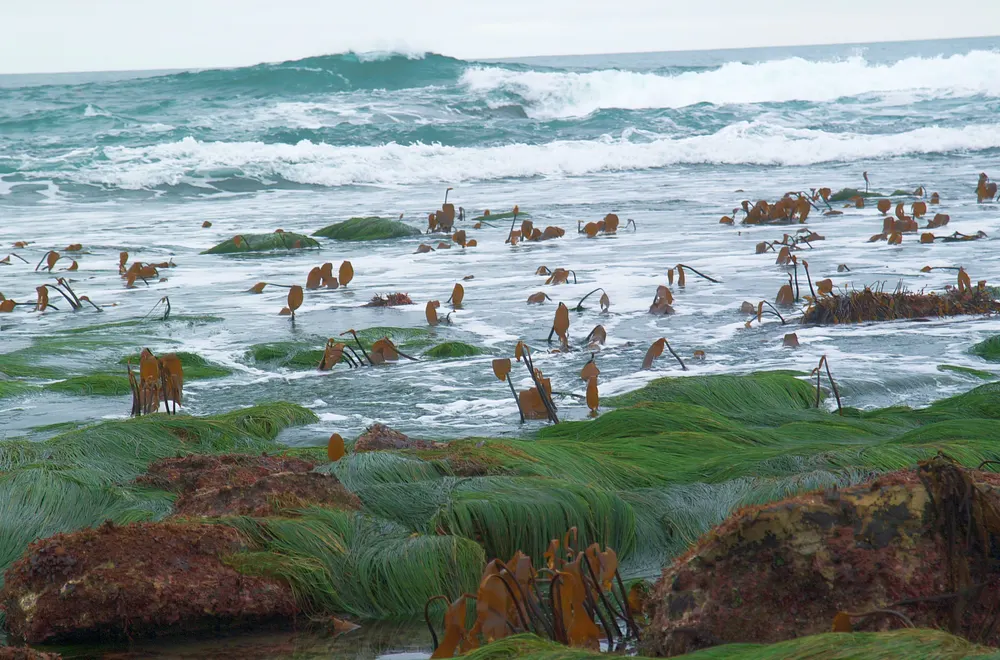
Photo: Laminariasetchellii.jpg: jkirkhart35 derivative work: Bff (talk), CC BY 2.0 (via Wikimedia Commons)
Scouler's Surfgrass
Phyllospadix scouleri
Also known as Surfgrass, Surf grass, Scouler's surf-grass
Traditional uses
✦Scouler's surfgrass is not a kitchen or medicine cabinet herb. It is a true flowering plant that returned to the sea millions of years ago, and along the Pacific coast it has long mattered to people in practical rather than medicinal ways. Coastal Indigenous communities are documented to have used the tough, fibrous blades of surfgrass and its estuarine cousin eelgrass for everyday needs such as lining steaming pits, packing and cushioning food or goods, stuffing bedding, and thatching, prizing the leaves for their strength and salt tolerance rather than for eating or healing. Its greater story is ecological: surfgrass meadows stabilize wave-swept rock, buffer the shoreline, and shelter countless small fish, snails, and crustaceans, making it one of the quiet architects of a healthy rocky coast.
How to grow & use it
✦The full apothecary for Scouler's Surfgrass
Traditional remedies and step-by-step preparations, a complete growing guide, and how to harvest, dry, and store it, all unlocked with HerbLens Unlimited.
- ✦Remedies & preparations
- ✦ Growing guide
- ✦Harvest & storage
From under $6 a month. Free plant identifications always included.
“For the rocks that wear green hair combed flat by every incoming wave, and never once go dry at heart.”
Surfgrass is one of the very few flowering plants on Earth that lives fully submerged in open seawater and pollinates underwater, releasing long thread-like pollen grains that drift on the current to find a mate, an adaptation almost unheard of outside this small group of marine seagrasses.
Not an established food or medicine, and as a marine plant it may carry pollutants, so it shouldn't be eaten.