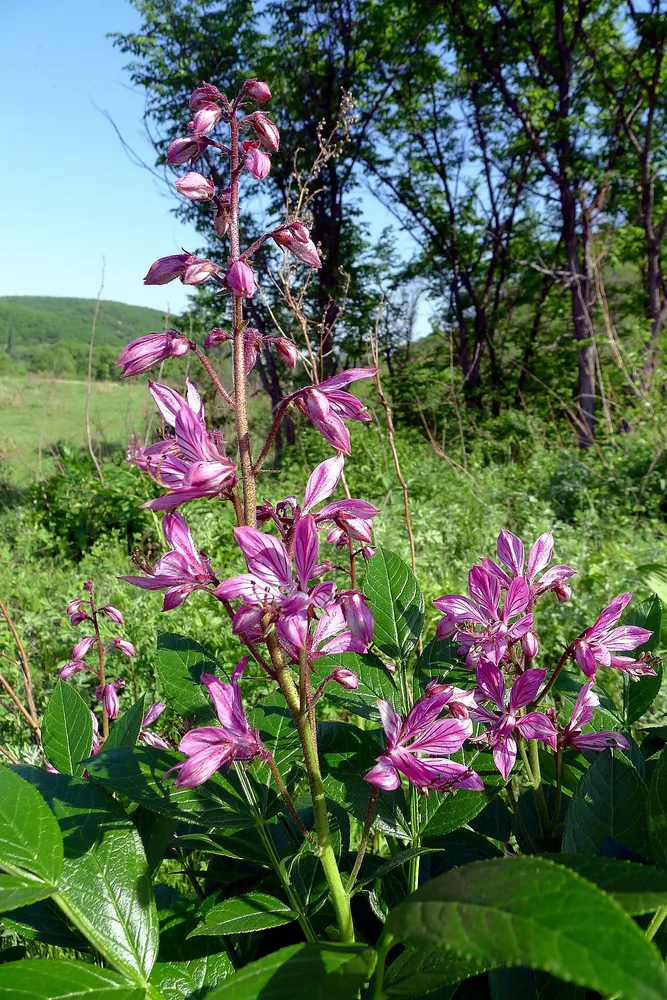
Photo: yakovlev.alexey from Moscow, Russia, CC BY-SA 2.0 (via Wikimedia Commons)
Burning Bush
Dictamnus dasycarpus
Also known as Gas Plant, Dittany, Chinese Dittany, Bai Xian Pi, Cortex Dictamni
Key benefits
✦Traditional uses
✦For generations the peeled root bark of Dictamnus dasycarpus, known in Chinese medicine as Bai Xian Pi, was simmered into decoctions meant to cool what practitioners called damp heat, the traditional explanation behind angry, weeping skin complaints like eczema and ringworm. Herbalists also worked it into formulas alongside other bitter, cooling roots for jaundice and for aching, swollen joints. In the garden, the plant earned an entirely separate kind of fame, prized by generations of growers not for its medicine chest but for the strange blue flash it can produce on a still summer night. Today it is respected as much for its history and its horticultural oddity as for any remedy still practiced.
How to grow & use it
✦The full apothecary for Burning Bush
Traditional remedies and step-by-step preparations, a complete growing guide, and how to harvest, dry, and store it, all unlocked with HerbLens Unlimited.
- ✦Remedies & preparations
- ✦ Growing guide
- ✦Harvest & storage
From under $6 a month. Free plant identifications always included.
- ✦Sophora root (Ku Shen)
- ✦Atractylodes (Cang Zhu)
- ✦Phellodendron (Huang Bai)
- ✦Sophora flavescens
- ✦Phellodendron amurense
“For the gardener drawn to a plant that seems to carry its own small flame just beneath the surface.”
On a hot, still evening the flowering spikes of Dictamnus release enough volatile oil into the air around them that a match held near the plant can produce a quick blue flash of flame without scorching a single petal, the very origin of the names burning bush and gas plant.
Internal use of the root bark has been linked to liver injury in modern case reports, so it should never be self-prescribed. The living plant's leaves, stems, and seed pods can cause severe burns and blistering if skin contact is followed by sunlight, so wear gloves and long sleeves when handling it and avoid it entirely during pregnancy or breastfeeding.