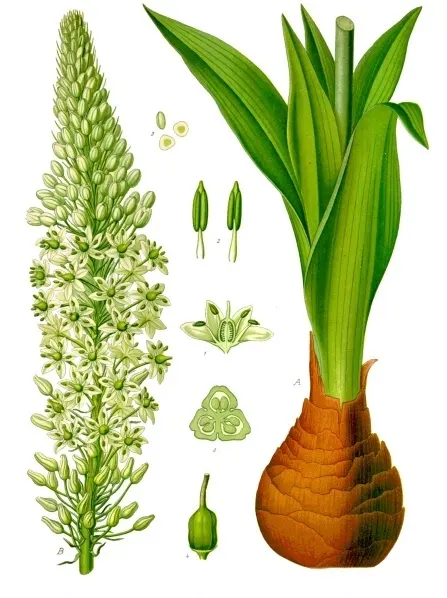
Photo: Franz Eugen Köhler, Köhler's Medizinal-Pflanzen, Public domain (via Wikimedia Commons)
Red Squill
Urginea maritima
Also known as Sea Squill, White Squill, Sea Onion, Drimia maritima, Scilla
Traditional uses
✦Red squill has one of the longest documented histories of any bulb in the Mediterranean world. Ancient Egyptian, Greek, and Roman physicians grew and prized it, and Pythagoras is said to have written a treatise on its properties. For centuries it held an official place in Western pharmacopoeias as a source of powerful cardiac glycosides, prepared into tinctures and syrups by trained apothecaries under careful, measured dosing, much the way foxglove gave rise to digitalis. That same bulb became famous in a very different role during the twentieth century, ground into a red-tinted rodenticide, because its bitter, emetic-inducing compounds caused most mammals to vomit it back up while rodents, who cannot vomit, could not. Today it survives mostly as a striking ornamental bulb and a chapter in the history of pharmacy rather than as anything meant for the home apothecary.
How to grow & use it
✦The full apothecary for Red Squill
Traditional remedies and step-by-step preparations, a complete growing guide, and how to harvest, dry, and store it, all unlocked with HerbLens Unlimited.
- ✦Remedies & preparations
- ✦ Growing guide
- ✦Harvest & storage
From under $6 a month. Free plant identifications always included.
“A bulb better admired from a garden path than ever brought inside.”
The dried, powdered bulb of red squill was so effective and so specific to rats and mice that it was used as a commercial rodenticide well into the mid-1900s, valued precisely because it made almost every other animal, including pets, vomit the dose before it could do harm, while rodents, lacking a vomiting reflex, could not.
Urginea maritima (red squill, sea squill) is genuinely toxic and should never be ingested, prepared as a home remedy, or given in any dose without professional medical and pharmaceutical supervision. The bulb contains potent cardiac glycosides, including scillaren and scilliroside, which act on the heart in the same family of compounds as digitalis from foxglove. Ingestion can cause nausea, vomiting, irregular heartbeat, and in significant doses, life-threatening cardiac effects; it has caused poisoning and death in both animals and humans. It is especially dangerous for anyone with heart conditions, anyone taking heart medications or diuretics, and is unsafe in pregnancy and for children and pets, who are frequently poisoned by mistaking the bulb for an edible one. All parts of the plant, particularly the bulb, should be considered unsafe to eat or brew in any form. If you are drawn to this plant, enjoy it strictly as an ornamental garden bulb, keep it out of reach of children and animals, and speak with a qualified physician or toxicologist rather than attempting any home preparation, and always consult a qualified healthcare professional before using any plant medicinally.