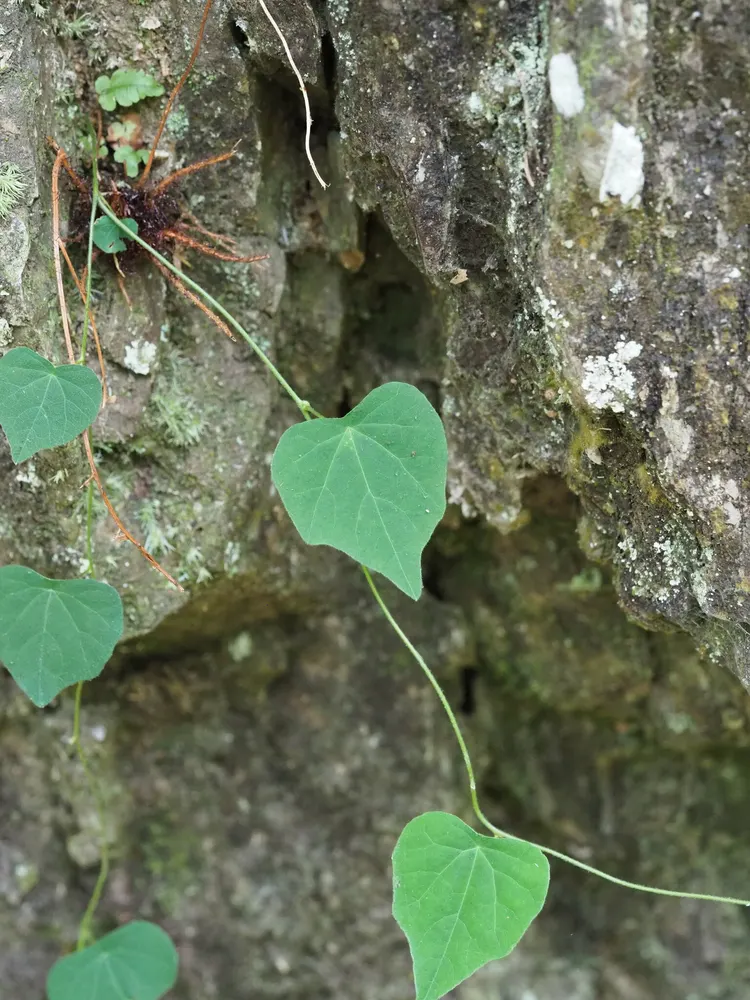
Photo: no rights reserved, CC0 (via Wikimedia Commons)
Tetrandrine (Han Fang Ji)
Stephania tetrandra
Also known as Han Fang Ji, Fang Ji, Stephania Root, Four-Stamen Stephania, Han Bing Ji
Traditional uses
✦In Chinese medicine, the root of Stephania tetrandra has been dug, sliced, and dried for centuries under the name Han Fang Ji, prized in classical formulas for supporting healthy fluid balance and easing the heavy, aching joints associated with damp, rainy climates. Old herbal texts group it among the water-regulating herbs, used alongside other roots to help move what practitioners called stagnant dampness from the body. It was also woven into formulas meant to calm an overheated, agitated pulse. Because of its potency, it was always treated as a physician's herb rather than a kitchen one, measured carefully and combined thoughtfully rather than taken alone.
How to grow & use it
✦The full apothecary for Tetrandrine (Han Fang Ji)
Traditional remedies and step-by-step preparations, a complete growing guide, and how to harvest, dry, and store it, all unlocked with HerbLens Unlimited.
- ✦Remedies & preparations
- ✦ Growing guide
- ✦Harvest & storage
From under $6 a month. Free plant identifications always included.
- ✦Astragalus root (Huang Qi), a classic companion in formulas addressing fluid balance
- ✦Job's tears (Coix seed, Yi Yi Ren), traditionally paired for its own dampness-clearing reputation
- ✦Atractylodes root (Bai Zhu), often included to support digestion within the same formulas
- ✦Regional Chinese formularies have sometimes used other Stephania species, such as Stephania cepharantha, though these are not interchangeable and should only be sourced and identified by a qualified practitioner
“A root with a long memory in old apothecary drawers, and a reminder that some traditions are best left in expert hands.”
The infamous 'Chinese herbs nephropathy' outbreak that hospitalized dozens of patients in Belgium during the 1990s was eventually traced not to Stephania tetrandra itself, but to a case of mistaken identity, where the toxic root Aristolochia fangchi was substituted for it due to nearly identical Chinese trade names. It remains one of the most cited case studies in botanical medicine on why correct plant identification is a matter of life and death.
Han Fang Ji root has repeatedly been confused with a related, far more toxic root, Aristolochia fangchi, a mix-up that caused kidney failure and cancer in patients using contaminated weight-loss products in the 1990s. Even correctly identified, tetrandrine can strain the kidneys and liver and interacts with blood pressure and calcium channel medications. It should only be used, if at all, under supervision of a licensed practitioner who can verify its identity, never for self-dosing, pregnancy, or nursing.