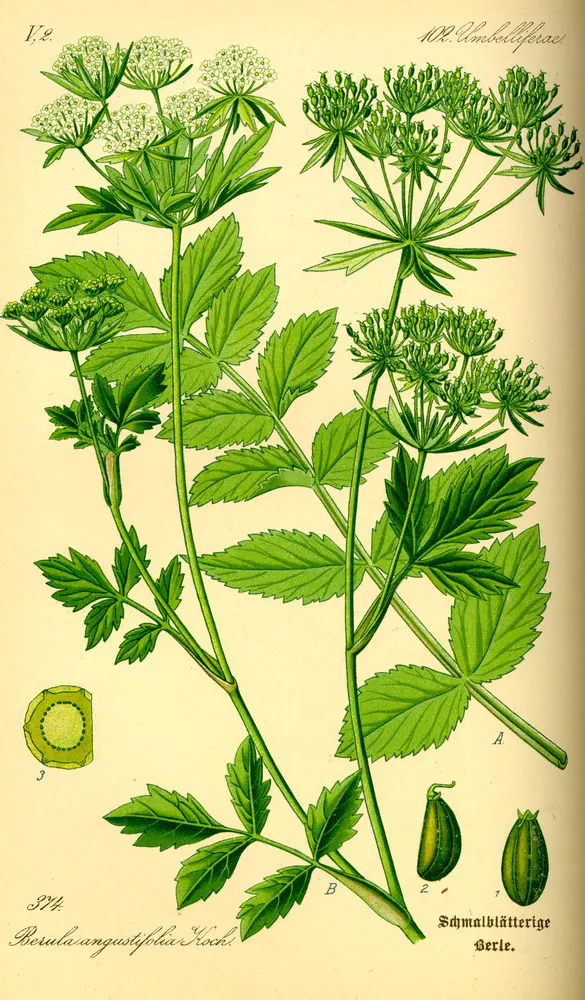
Photo: Public domain (via Wikimedia Commons)
Lesser Water-Parsnip
Berula erecta
Also known as Lesser Water-Parsnip, Cut-leaved Water-Parsnip, Narrow-leaved Water-Parsnip
Key benefits
✦Traditional uses
✦Berula erecta has long grown quietly at the edges of clear, spring-fed streams and watercress beds across Europe, Asia, and North America, more often noticed by naturalists than gathered by herbalists. Because it belongs to the carrot family and shares its wet habitat with some of the most dangerous plants in the temperate world, it never developed the kind of trusted culinary or medicinal tradition that cousins like wild carrot or fennel enjoyed. Where it does appear in old foraging notes, it is usually mentioned as a caution rather than a recommendation, a reminder that not every feathery-leaved, white-flowered streamside plant is safe to eat. Today it is valued mostly by naturalists and water-gardeners for the clean, cress-like green it brings to a streambank and the cover it offers to small fish and invertebrates.
How to grow & use it
✦The full apothecary for Lesser Water-Parsnip
Traditional remedies and step-by-step preparations, a complete growing guide, and how to harvest, dry, and store it, all unlocked with HerbLens Unlimited.
- ✦Remedies & preparations
- ✦ Growing guide
- ✦Harvest & storage
From under $6 a month. Free plant identifications always included.
- ✦Watercress (Nasturtium officinale)
- ✦Brooklime (Veronica beccabunga)
- ✦Water mint (Mentha aquatica)
- ✦Watercress, for a safely identifiable peppery streamside green
- ✦Water mint, for fragrant foliage at a pond's edge
“For the clear, cold edge of a chalk stream, where the water runs clean enough to grow it, and clean enough to remind you why some plants are best simply admired.”
Berula erecta was for many years classified in the genus Sium, and botanists still sometimes group it among the water-parsnips, a name that quietly hints at the family's reputation, since several of its closest relatives rank among the most lethal plants a forager can ever encounter.
Berula erecta grows alongside water hemlock and hemlock water-dropwort, among the most poisonous plants in the Northern Hemisphere, which can be fatal in small amounts and are hard to tell apart from it. Do not forage or eat this plant; leave identification to a trained botanist.