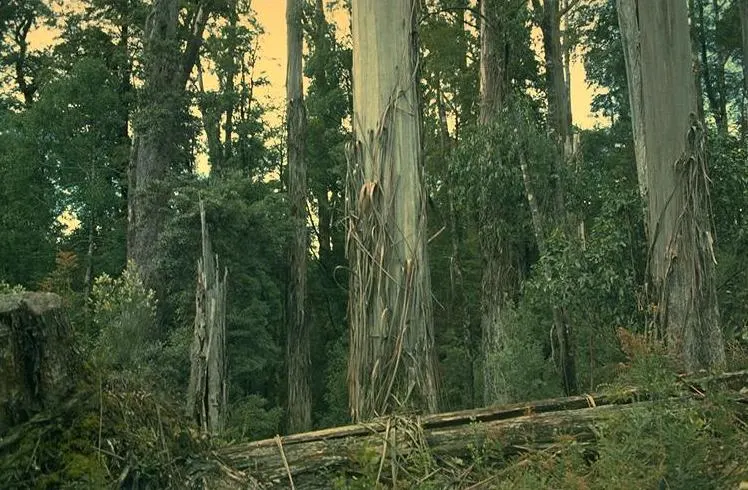
Photo: Ian Brooker and David Kleinig, CC BY 3.0 au (via Wikimedia Commons)
Brooker's Gum
Eucalyptus brookeriana
Also known as Brooker's Eucalyptus, Brookeriana Gum
Key benefits
✦Traditional uses
✦Brooker's Gum is one of Tasmania's tall wet-forest eucalypts, named for the Australian botanist M.I.H. Brooker, who spent his career mapping and describing the eucalypt family. It has not carried the long, well-documented medicinal history of its famous cousin, Eucalyptus globulus, the Tasmanian Blue Gum whose leaf became a mainstay of colonial and folk respiratory remedies. Instead, Brooker's Gum has traditionally been valued in its home range as a fast-growing timber and shelter tree and as a source of nectar for the region's celebrated eucalypt honeys. Because it shares the same aromatic, oil-rich leaves common to the genus, bruised foliage has sometimes been gathered in the bush the way other eucalypts were, crushed and breathed in for their sharp, clearing scent on a cold or congested day.
How to grow & use it
✦The full apothecary for Brooker's Gum
Traditional remedies and step-by-step preparations, a complete growing guide, and how to harvest, dry, and store it, all unlocked with HerbLens Unlimited.
- ✦Remedies & preparations
- ✦ Growing guide
- ✦Harvest & storage
From under $6 a month. Free plant identifications always included.
- ✦Peppermint
- ✦Thyme
- ✦Rosemary
- ✦Eucalyptus globulus (Tasmanian Blue Gum)
- ✦Peppermint
“For the sharp, clean scent of a wet Tasmanian forest, carried on a breath of steam.”
Brooker's Gum is unusual among eucalypts for tolerating the boggy, poorly drained valley flats of the Tasmanian highlands, ground that would leave most of its drainage-loving relatives struggling.
Eucalyptus leaf and oil are toxic if swallowed and can seriously harm children and pets even in small amounts, so they are never taken internally; undiluted oil should also be kept off the skin, especially on infants.