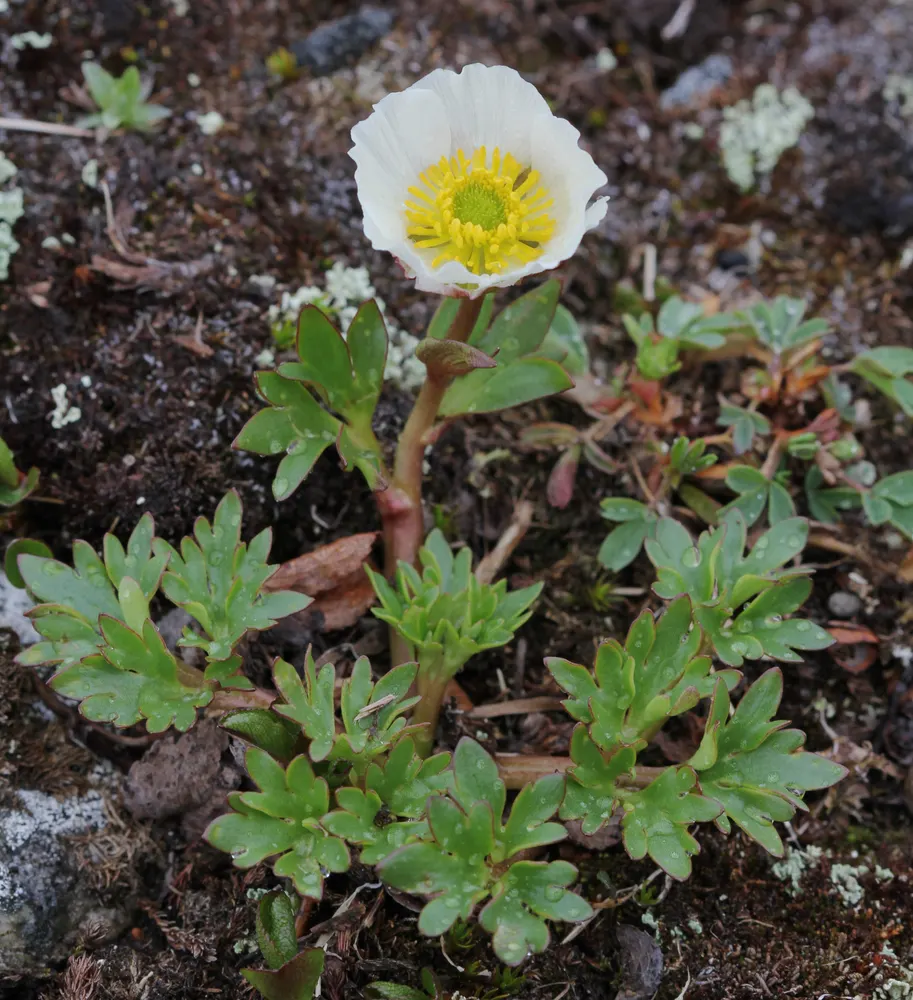
Photo: Alinja, CC BY-SA 3.0 (via Wikimedia Commons)
Glacier Buttercup
Ranunculus glacialis
Also known as Glacier Crowfoot, Alpine Glacier Buttercup, Ranunculus des glaciers
Key benefits
✦Traditional uses
✦Glacier Buttercup does not carry a history in the herbalist's cabinet the way many of its lowland cousins do. What it carries instead is a reputation among mountaineers and botanists as one of the boldest flowers in Europe, a plant that pushes its roots into gravel barely free of ice and opens its petals within days of the snow's retreat. Alpine explorers and naturalists of the nineteenth century prized sightings of it near mountain summits as proof of just how far life could climb, and it still shows up in accounts of high-altitude botany as a marker of the tree line's opposite extreme. Like its buttercup relatives, it was traditionally left alone by herders and foragers alike, since fresh Ranunculus foliage is acrid and irritating rather than useful.
How to grow & use it
✦The full apothecary for Glacier Buttercup
Traditional remedies and step-by-step preparations, a complete growing guide, and how to harvest, dry, and store it, all unlocked with HerbLens Unlimited.
- ✦Remedies & preparations
- ✦ Growing guide
- ✦Harvest & storage
From under $6 a month. Free plant identifications always included.
“For the flower that blooms where the map stops calling it a meadow and starts calling it a glacier.”
Glacier Buttercup holds the record for one of the highest elevations ever recorded for a flowering plant in Europe, having been found blooming above 4,200 meters on the rocky flanks of the Dom in the Swiss Alps, well into the realm of permanent snow and ice. Its white petals also blush pink as they age, a trick thought to help the aging flower soak up a little more warmth from the thin mountain sun once the freshest blooms nearby have stolen the pollinators' attention.
Like other buttercups, glacier buttercup contains ranunculin, which turns into the acrid irritant protoanemonin when the plant is bruised or chewed, causing skin blistering and painful mouth and throat irritation. It has no food or herbal use and should never be eaten or applied to the skin.