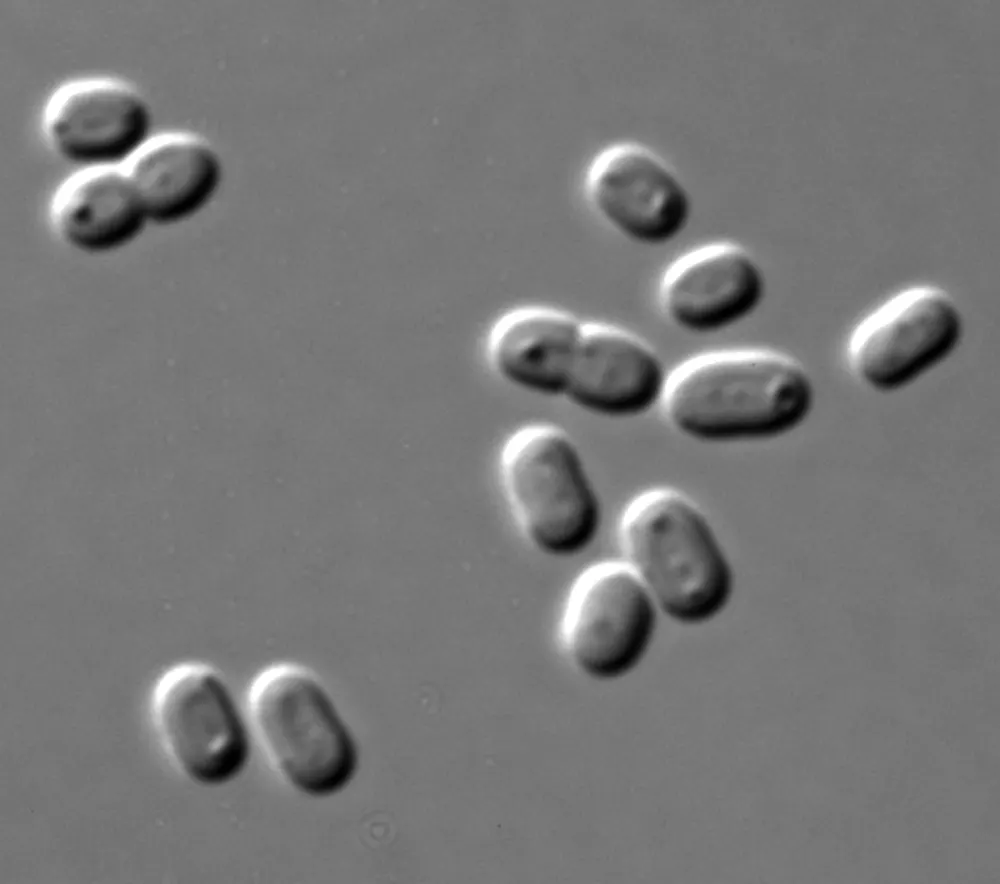
Photo: Masur, Public domain (via Wikimedia Commons)
Thermophilic Cyanobacterium
Thermosynechococcus elongatus
Also known as T. elongatus BP-1, Hot-spring blue-green algae
Key benefits
✦Traditional uses
✦Thermosynechococcus elongatus carries no folk tradition the way a garden herb does. It was unknown to healers, cooks, and herbalists alike until the twentieth century, when microbiologists surveying the scalding waters of Japanese hot springs found this hardy, heat-loving cyanobacterium thriving where almost nothing else could live. Its real legacy is a scientific one. Because its proteins hold up unusually well to the heat and handling required in the lab, this organism became one of the most important tools for unlocking the molecular machinery of photosynthesis, and in 2001 researchers used protein isolated from it to solve the first atomic-resolution structure of Photosystem II, the complex that lets plants, algae, and cyanobacteria split water using sunlight.
How to grow & use it
✦The full apothecary for Thermophilic Cyanobacterium
Traditional remedies and step-by-step preparations, a complete growing guide, and how to harvest, dry, and store it, all unlocked with HerbLens Unlimited.
- ✦Remedies & preparations
- ✦ Growing guide
- ✦Harvest & storage
From under $6 a month. Free plant identifications always included.
“For the curious mind drawn to the tiny, heat-loving engines that first taught us how sunlight becomes life.”
Protein isolated from Thermosynechococcus elongatus was used to solve the first atomic-resolution crystal structure of Photosystem II in 2001, a discovery that finally showed scientists, molecule by molecule, how plants and algae use sunlight to split water and release the oxygen we breathe.
This is a laboratory research organism studied for photosynthesis, not a food or supplement, and it has no history of human consumption. It should never be collected from hot springs and eaten or brewed.