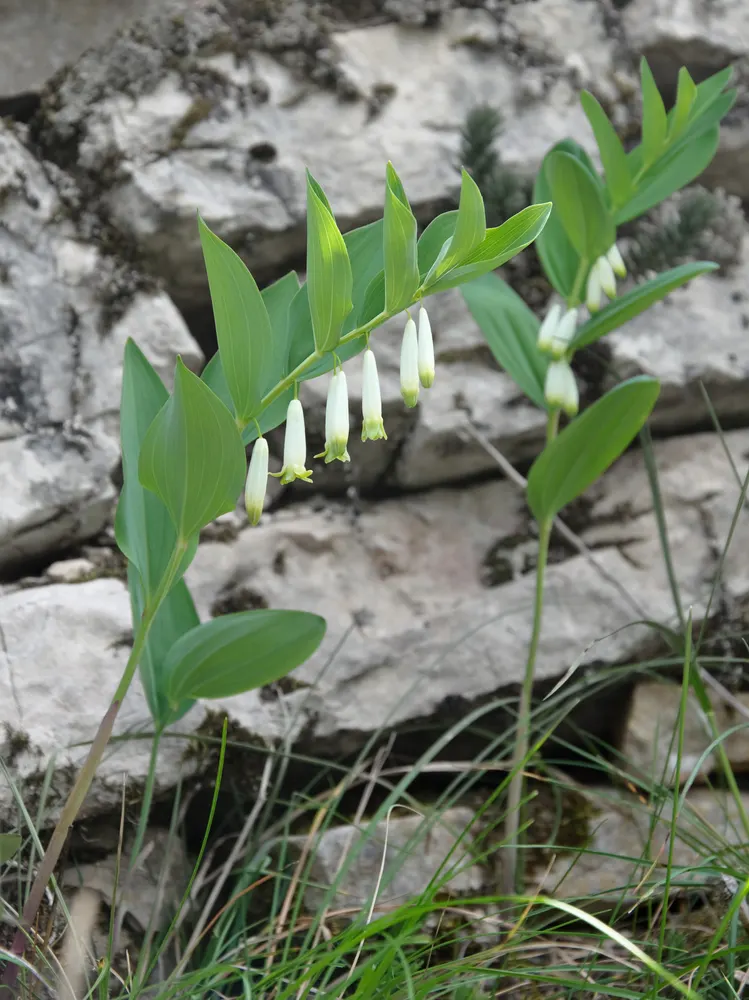
Photo: Myrabella, CC BY-SA 3.0 (via Wikimedia Commons)
Fragrant Solomon's Seal
Polygonatum odoratum
Also known as Yu Zhu, Scented Solomon's Seal, Angular Solomon's Seal, Sweet-Scented Solomon's Seal
Key benefits
✦Traditional uses
✦In Chinese herbal medicine, the cured rhizome of this plant, known as Yu Zhu, has been simmered into tonics for centuries to nourish what practitioners call yin, the body's cooling, moistening reserves. It found its way into recovery broths for people worn thin by fever or long illness, valued for a mild sweetness and a gentle, almost mucilaginous quality believed to soothe dryness in the throat and lungs. Elders in some regions kept a jar of the sliced, honey-cured root on hand the way a grandmother might keep chicken soup ready, a quiet standby for the dry cough and low energy that come with the changing seasons. Its cousins in the Solomon's Seal family carry similar folklore across Europe and North America, where the arching, jointed rhizome itself became a small piece of garden poetry.
How to grow & use it
✦The full apothecary for Fragrant Solomon's Seal
Traditional remedies and step-by-step preparations, a complete growing guide, and how to harvest, dry, and store it, all unlocked with HerbLens Unlimited.
- ✦Remedies & preparations
- ✦ Growing guide
- ✦Harvest & storage
From under $6 a month. Free plant identifications always included.
- ✦Astragalus root
- ✦American ginseng
- ✦Goji berry (Lycium)
- ✦Polygonatum sibiricum (Huang Jing, a related Solomon's Seal)
- ✦Asparagus root (Asparagus cochinchinensis)
“For the quiet dryness of a long season, when the throat feels parched and the body could use something gentle to lean on.”
The genus name Polygonatum comes from the Greek for 'many knees,' a nod to the row of round scars left along the rhizome each year when the stem dies back, so that counting them, much like counting tree rings, can tell you roughly how old the plant is.
Only the cooked, cured rhizome is used; the berries are considered inedible and potentially toxic and should never be eaten. Before flowering, this plant can be confused with toxic look-alikes like false hellebore, so positive identification is essential when foraging.