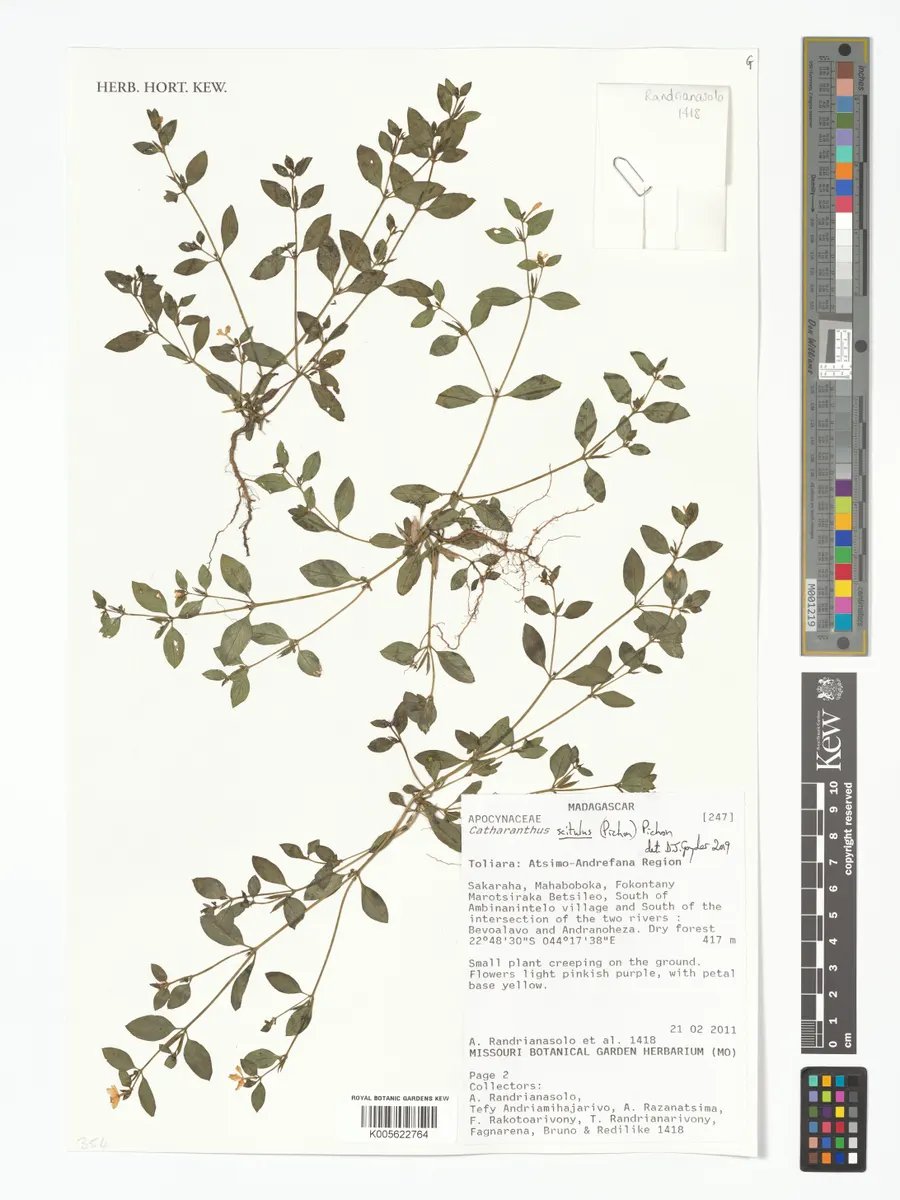
Photo: Royal Botanic Gardens, Kew, CC BY (via GBIF)
Madagascar Rock Periwinkle
Catharanthus scitulus
Also known as Scitulus Periwinkle, Slender Madagascar Periwinkle
Key benefits
✦Traditional uses
✦Catharanthus scitulus is one of the lesser known cousins of the famous Madagascar periwinkle, Catharanthus roseus, and it shares that plant's homeland among the rocky outcrops and dry forests of Madagascar. It has never held a place in folk medicine or kitchen herbalism the way many entries in this atlas do. Instead, its story belongs to botanists and collectors, who prize it for its resilience in harsh, stony ground and for the quiet beauty of its wheel-shaped blooms. Its real significance lies in its family tree, since close relatives in the genus Catharanthus gave the modern world two of its most important cancer medicines.
How to grow & use it
✦The full apothecary for Madagascar Rock Periwinkle
Traditional remedies and step-by-step preparations, a complete growing guide, and how to harvest, dry, and store it, all unlocked with HerbLens Unlimited.
- ✦Remedies & preparations
- ✦ Growing guide
- ✦Harvest & storage
From under $6 a month. Free plant identifications always included.
- ✦Aloe (as a fellow dry-garden companion)
- ✦Lantana
- ✦Ornamental sedum
- ✦For a safer flowering ground cover with a similar look, try garden vinca minor (Vinca minor), grown strictly as an ornamental as well
“A rare Madagascar jewel meant for the garden bed, not the teacup.”
Catharanthus scitulus belongs to the same small Madagascar genus as Catharanthus roseus, whose alkaloids led to vincristine and vinblastine, two chemotherapy drugs that transformed the treatment of childhood leukemia. That discovery came from careful laboratory research, never from home use of the raw plant.
Like its well known relative Catharanthus roseus, Catharanthus scitulus almost certainly contains potent alkaloids from the same toxic family that produces powerful, medically regulated compounds such as vincristine and vinblastine. Ingesting any part of this plant can be dangerous, potentially causing serious toxicity, and it should never be brewed, eaten, or self-administered in any form. It is also considered toxic to pets and livestock if chewed or swallowed. This plant should be grown and enjoyed strictly as an ornamental specimen, kept out of reach of children and animals, and never treated as a home remedy. If ingestion is ever suspected, contact a poison control center or medical professional right away, and always consult a qualified healthcare provider before using any plant medicinally.