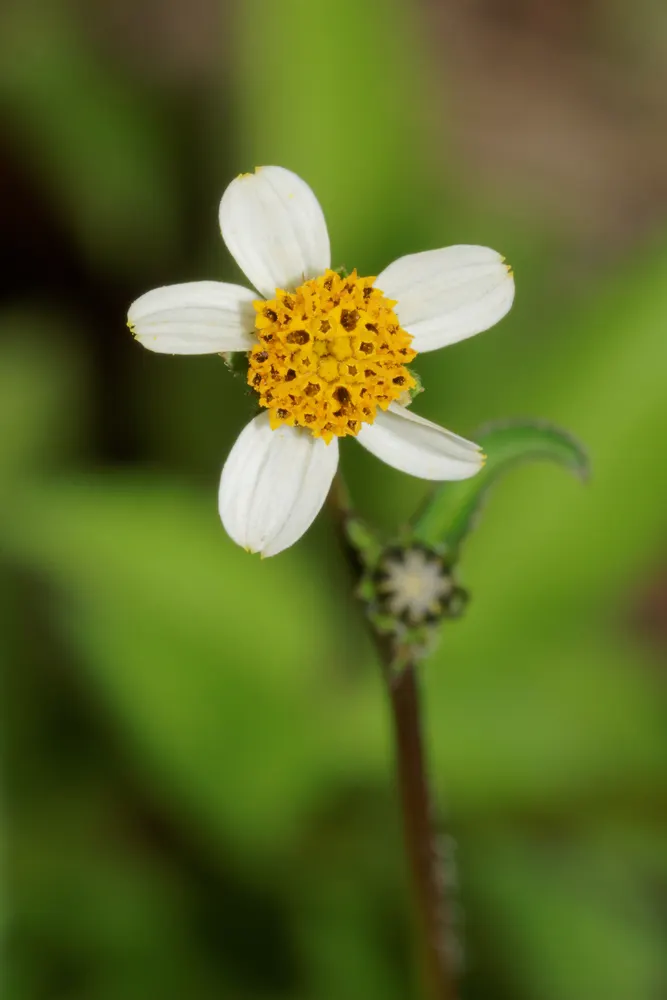
Photo: Jeevan Jose, Kerala, India, CC BY-SA 4.0 (via Wikimedia Commons)
Spanish Needle
Bidens pilosa
Also known as Beggar's Ticks, Blackjack, Farmer's Friend, Cobbler's Pegs, Shepherd's Needle
Key benefits
✦Traditional uses
✦Long before it was studied in a laboratory, Spanish needle was already a fixture of household medicine chests on nearly every continent it reached. In West and East Africa it has traditionally been used as a poultice for cuts and skin irritation and as a tea for fevers and stomach troubles, while in Taiwan and across Latin America healers have steeped it for sore throats, upset stomachs, and general tonic support. It is also simply eaten, its young leaves tossed into soups and stews as a everyday leafy green, which is part of why this unassuming roadside weed became one of the most independently rediscovered medicinal plants in the world. Few herbs carry such a consistent reputation for gentle, all-purpose usefulness across so many unconnected cultures.
How to grow & use it
✦The full apothecary for Spanish Needle
Traditional remedies and step-by-step preparations, a complete growing guide, and how to harvest, dry, and store it, all unlocked with HerbLens Unlimited.
- ✦Remedies & preparations
- ✦ Growing guide
- ✦Harvest & storage
From under $6 a month. Free plant identifications always included.
- ✦Lemongrass
- ✦Ginger
- ✦Moringa
- ✦Dandelion leaf
- ✦Cleavers
“For the little roadside weed that quietly became a medicine chest on every continent it touched.”
Those barbed, needle-like seeds that give this plant its common names are a hitchhiking strategy: they catch on fur, feathers, and trouser cuffs so effectively that Spanish needle has ridden its way to nearly every warm region on Earth, becoming one of the most widespread weeds in the world.
Eaten as a leaf vegetable and folk tea and not considered toxic, but its blood sugar and blood pressure lowering effects mean it can add to diabetes or blood pressure medications. Confirm identification before foraging, since it resembles other roadside weeds, and it's best avoided during pregnancy and nursing since safety data is limited.