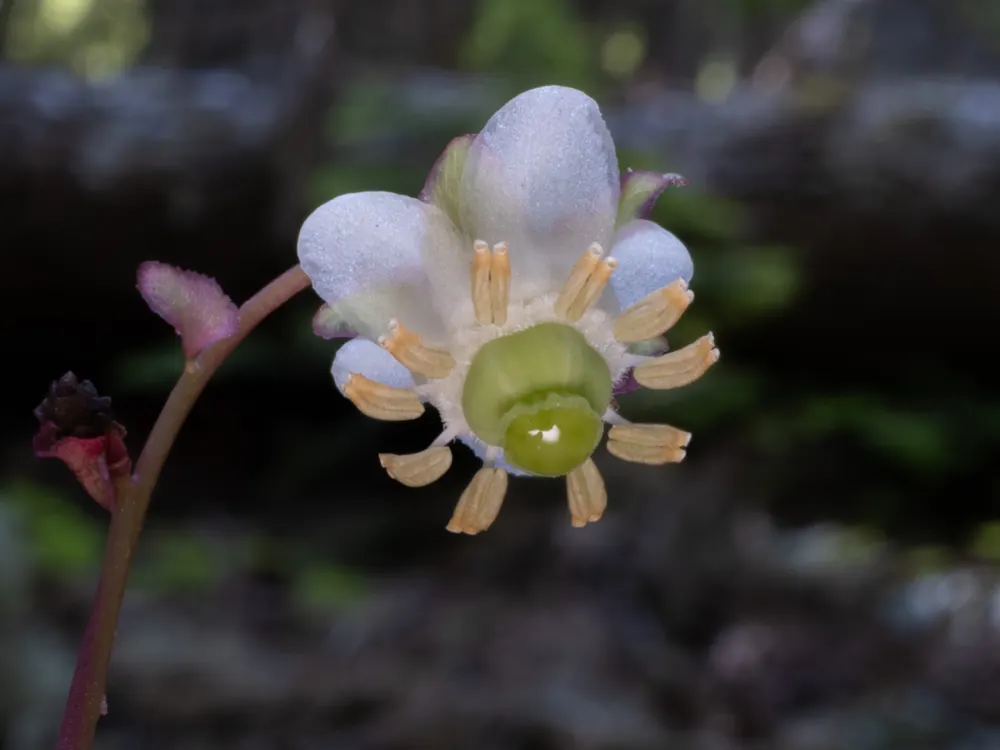
Photo: Alex Abair, CC BY 4.0 (via Wikimedia Commons)
Little Prince's Pine
Chimaphila menziesii
Also known as Menzies' Pipsissewa, Little Pipsissewa, Woodland Wintergreen
Key benefits
✦Traditional uses
✦Little Prince's Pine is the smaller, shyer sibling of common pipsissewa, tucked into the shaded duff beneath old conifers where few other plants bother to grow. Indigenous peoples of the Pacific Northwest and California who knew this plant traditionally treated it much like its larger relative, using the leaves in mild infusions thought to support the kidneys and bladder and to ease the aches of rheumatism. Because it grows so sparingly and depends on the forest's own fungal networks to thrive, it was never gathered in the quantities that its more common cousin was, and much of what herbalists know about it today is borrowed from that closer relation. It remains, above all, a plant of quiet respect rather than heavy harvest.
How to grow & use it
✦The full apothecary for Little Prince's Pine
Traditional remedies and step-by-step preparations, a complete growing guide, and how to harvest, dry, and store it, all unlocked with HerbLens Unlimited.
- ✦Remedies & preparations
- ✦ Growing guide
- ✦Harvest & storage
From under $6 a month. Free plant identifications always included.
- ✦Uva ursi
- ✦Corn silk
- ✦Mullein leaf
- ✦Chimaphila umbellata (common pipsissewa)
- ✦Uva ursi
“For the quiet evergreen that keeps its green leaves tucked under pine duff long after the forest floor has gone to sleep for winter.”
The genus name Chimaphila comes from the Greek words for winter and love, meaning roughly winter loving, a nod to the way its glossy leaves stay green under the snow. The species name honors Archibald Menzies, the Scottish surgeon and botanist who collected plants along the Pacific coast during Vancouver's 1790s expedition, the same voyage that put his name on the Pacific madrone.
Little prince's pine may contain arbutin, like its relative pipsissewa, and is best avoided in large or frequent doses, during pregnancy and breastfeeding, and by anyone with kidney disease. It is rare and slow growing, so harvest only a leaf or two if any at all.