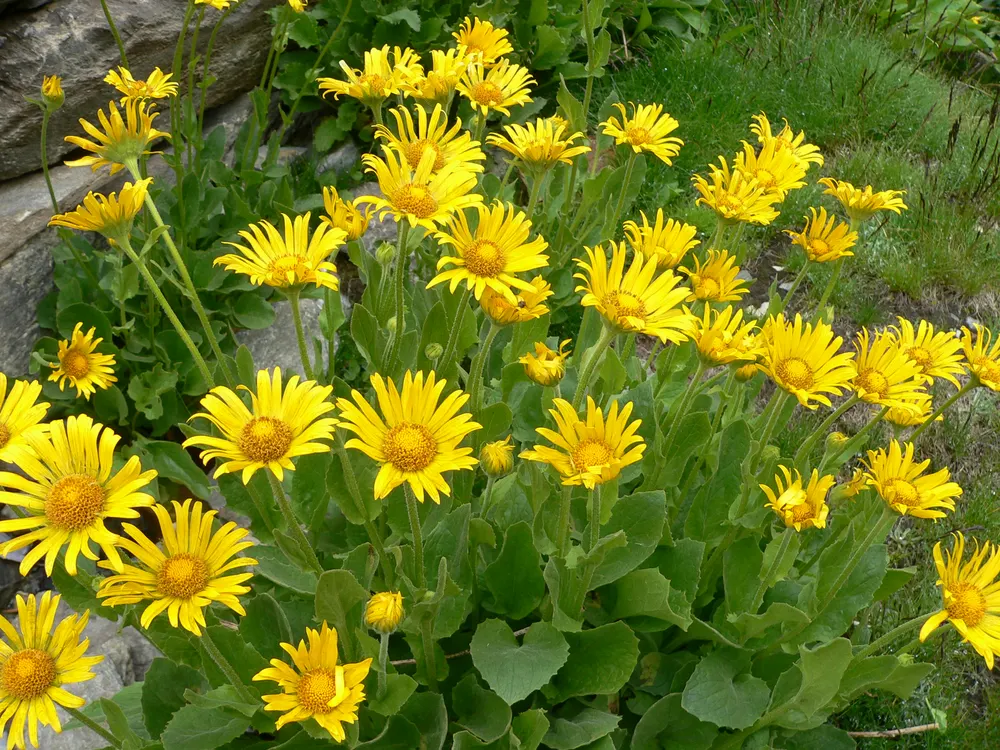
Photo: No machine-readable author provided. Philipendula assumed (based on copyright claims)., CC BY-SA 3.0 (via Wikimedia Commons)
Large-flowered Leopard's Bane
Doronicum grandiflorum
Also known as Alpine Leopard's Bane, Large-flowered Doronicum, Mountain Doronicum
Key benefits
✦Traditional uses
✦Large-flowered leopard's bane belongs to a genus whose common name carries an old and rather dark story. Doronicum roots were once believed so potent that mountain villagers ground them into bait to poison wolves, foxes, and even leopards, which is where the entire genus earned the name leopard's bane. Because of this reputation, the plant was regarded with more caution than curiosity, and unlike its lookalike cousin arnica, it never became a staple of the herbalist's cabinet. Its real legacy today is a horticultural one: alpine gardeners and mountain botanists have long prized it simply for the way its golden daisies light up a stony slope while snow still lingers nearby.
How to grow & use it
✦The full apothecary for Large-flowered Leopard's Bane
Traditional remedies and step-by-step preparations, a complete growing guide, and how to harvest, dry, and store it, all unlocked with HerbLens Unlimited.
- ✦Remedies & preparations
- ✦ Growing guide
- ✦Harvest & storage
From under $6 a month. Free plant identifications always included.
- ✦Alpine aster
- ✦Saxifrage
- ✦Mountain avens
- ✦Arnica montana (for ornamental alpine gardens only, not as a substitute in any internal remedy)
“For the moment the snow retreats and a rocky alpine bank needs its first gold.”
The genus name Doronicum shares its poisonous reputation with a close relative, Doronicum pardalianches, whose species name literally means panther strangler in old herbal Latin, because its roots were once used to bait and kill big cats.
This plant has a long history as a poison, its root was traditionally used to kill wolves and wildcats, and it should never be eaten or brewed. Its foliage and sap can also irritate skin, so wear gloves when handling it and keep it away from pets and livestock.