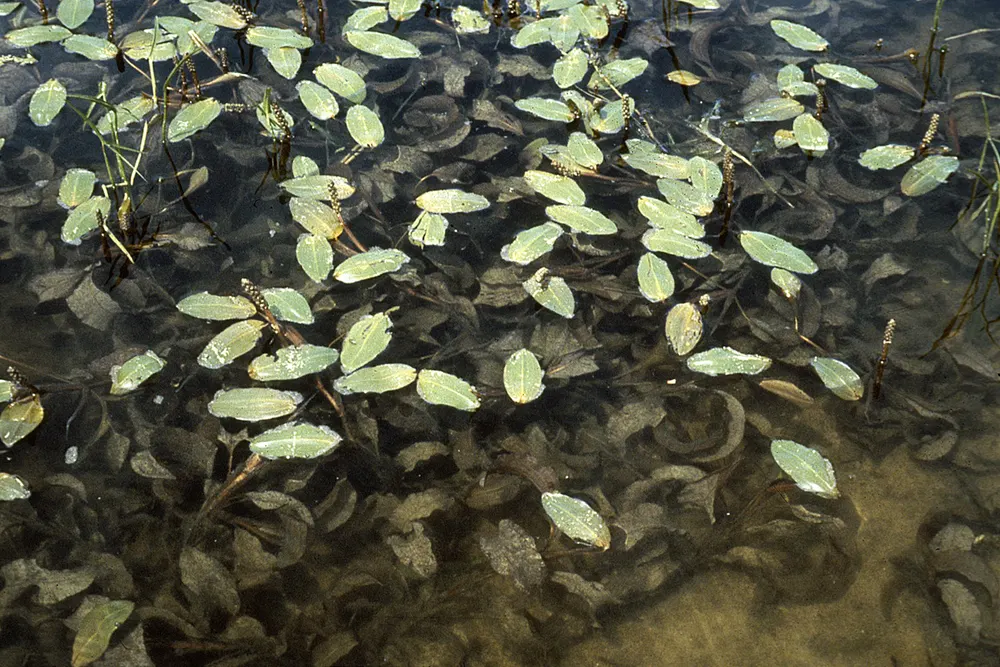
Photo: Edward G. Voss. USDA NRCS. 1995. Northeast wetland flora: Field office guide to plant species. Northeast National Technical Center, Chester. Courtesy of USDA NRCS Wetland Science Institute., Public domain (via Wikimedia Commons)
Large-leaf Pondweed
Potamogeton amplifolius
Also known as Large-leaf pondweed, Broad-leaved pondweed, Bass weed, Musky weed
Key benefits
✦Traditional uses
✦Large-leaf pondweed has never been an herbalist's plant, but it has long been a keystone one. Waterfowl hunters and old-time naturalists learned to read a lake by its pondweed beds, since ducks, geese, and marsh birds gather to feed on the seeds and starchy tubers each fall. Anglers came to call it musky weed and bass weed for the same reason bass and muskellunge do, because its dense underwater leaves offer exactly the cover a hunting fish wants. Its value has always been ecological rather than medicinal, a quiet, unglamorous plant that holds a lake together from the bottom up.
How to grow & use it
✦The full apothecary for Large-leaf Pondweed
Traditional remedies and step-by-step preparations, a complete growing guide, and how to harvest, dry, and store it, all unlocked with HerbLens Unlimited.
- ✦Remedies & preparations
- ✦ Growing guide
- ✦Harvest & storage
From under $6 a month. Free plant identifications always included.
- ✦Sago pondweed
- ✦Wild celery (Vallisneria)
- ✦Water lily
- ✦Clasping-leaf pondweed
- ✦Sago pondweed
“When a quiet pond needs its fish, frogs, and ducks to feel at home again.”
Large-leaf pondweed grows two completely different leaf shapes on the very same stem, thin ribbon-like leaves underwater and firm oval leaves floating on top, a trick called heterophylly that once led early botanists to mistake the two forms for separate species.
Large-leaf pondweed has no history of being eaten and is not recommended for eating, partly because wild aquatic plants can carry pollutants or bacteria.