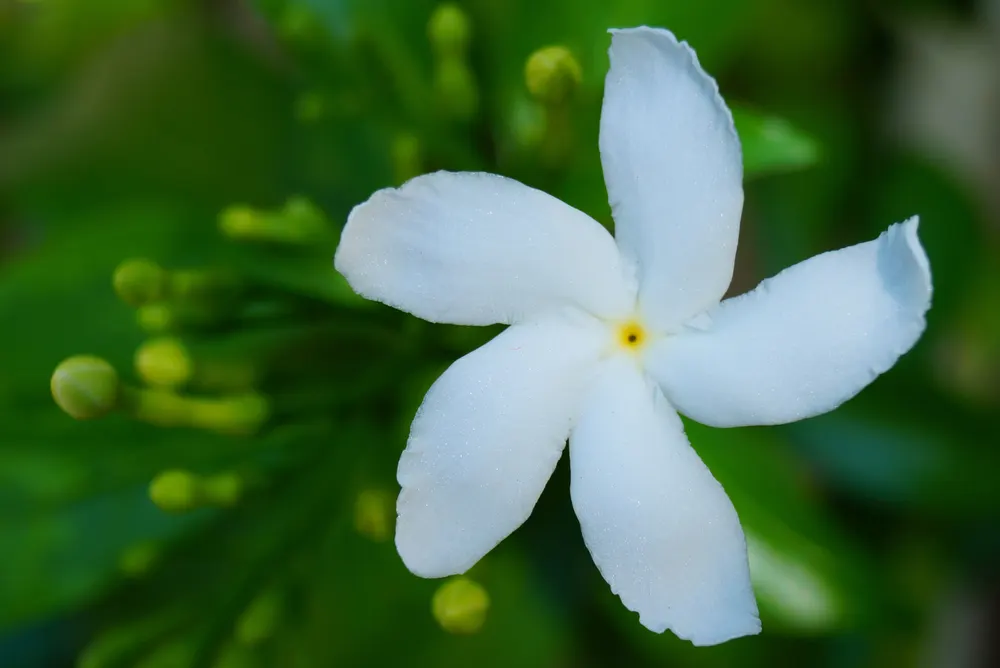
Photo: SKsiddhartthan, CC BY-SA 4.0 (via Wikimedia Commons)
Crape Jasmine
Tabernaemontana divaricata
Also known as Pinwheel Flower, East Indian Rosebay, Crepe Gardenia, Nero's Crown, Wax Flower
Key benefits
✦Traditional uses
✦Across its native range, crape jasmine has long stood outside temples and courtyards, prized simply for the way its pinwheel flowers scent the evening air. In traditional Ayurvedic and Southeast Asian folk practice, the root and latex were noted by healers for use on the skin, gums, and eyes, and the plant carried a reputation as a treatment worth approaching with real caution. That caution has held up. Modern botanical study has confirmed that Tabernaemontana divaricata belongs to a genus rich in potent alkaloids, so its place today is firmly in the ornamental garden rather than the medicine cabinet.
How to grow & use it
✦The full apothecary for Crape Jasmine
Traditional remedies and step-by-step preparations, a complete growing guide, and how to harvest, dry, and store it, all unlocked with HerbLens Unlimited.
- ✦Remedies & preparations
- ✦ Growing guide
- ✦Harvest & storage
From under $6 a month. Free plant identifications always included.
- ✦True jasmine (Jasminum sambac)
- ✦Gardenia
- ✦Ixora
- ✦True jasmine (Jasminum sambac)
- ✦Gardenia
“Choose crape jasmine when you want a hedge that perfumes the evening and keeps flowering long after everything else has stopped.”
Crape jasmine's double-flowered form, sometimes called crepe gardenia, opens into tight little rosettes that fool most visitors into thinking they are looking at a miniature rose or a true gardenia, even though the plant is unrelated to either. It is, however, a close botanical cousin of Tabernanthe iboga, the West African shrub known for its powerful alkaloids, which is a hint at why crape jasmine's sap deserves careful handling.
Tabernaemontana divaricata is a genuinely toxic ornamental, not a culinary or medicinal herb, and should never be eaten or brewed. Every part of the plant contains a milky white latex bearing indole alkaloids, and the genus Tabernaemontana is chemically related to Tabernanthe iboga, the source of ibogaine; ingesting any part of this plant can cause vomiting, and contact with the sap commonly irritates skin and eyes. Keep it well away from children and pets who might chew on leaves, stems, or seed pods, and always wear gloves when pruning or taking cuttings. Because of its toxicity, it is not appropriate for use during pregnancy or breastfeeding, or in any home remedy. Historical folk use of the root and latex in Ayurvedic and Southeast Asian traditions reflects practices from healers working with fresh plant material under specific conditions, not a basis for safe home use today. If you are drawn to this plant for its traditional reputation, please speak with a qualified herbalist, toxicologist, or physician rather than preparing anything from it yourself.