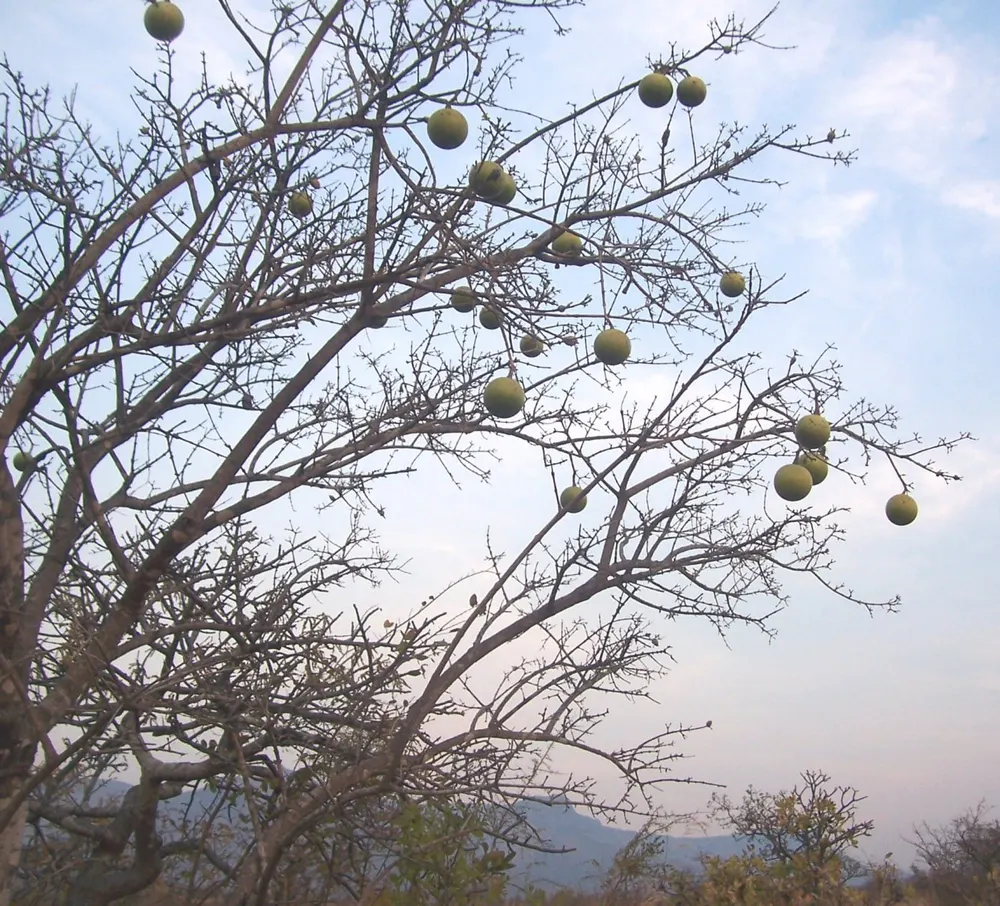
Photo: Damien Farrell, CC BY-SA 3.0 (via Wikimedia Commons)
Spiny Monkey Orange
Strychnos spinosa
Also known as Spiny Monkey Orange, Monkey Orange, Green Monkey Orange, Natal Orange
Traditional uses
✦In the bushveld and savanna woodlands of sub-Saharan Africa, the spiny monkey orange has long been a welcome roadside find, its hard, woody-shelled fruit cracked open by hand or against a stone to reach the sweet, tangy pulp inside. Communities across southern and eastern Africa, along with foraging troops of monkeys and baboons who gave the tree its common name, have gathered the ripe fruit for generations, eating it fresh, stirring it into porridge, or fermenting it into a traditional beer. The tough timber has also served as fuel and small tool handles, and the tree itself is valued as a hardy, drought-tolerant presence in dry-country gardens and wild spaces. Because this is a plant of caution as much as reward, its traditional value has always come with the understanding that only the fully ripe pulp is food, and every other part is left alone.
How to grow & use it
✦The full apothecary for Spiny Monkey Orange
Traditional remedies and step-by-step preparations, a complete growing guide, and how to harvest, dry, and store it, all unlocked with HerbLens Unlimited.
- ✦Remedies & preparations
- ✦ Growing guide
- ✦Harvest & storage
From under $6 a month. Free plant identifications always included.
- ✦Baobab fruit
- ✦Marula
- ✦Wild sorghum
- ✦Corky Monkey Orange (Strychnos cocculoides)
- ✦Black Monkey Orange (Strychnos madagascariensis)
“For the patient forager who knows a bushveld trail, and knows exactly which part of the fruit to trust.”
The tree's common name comes from the vervet monkeys and baboons that are regularly seen cracking the fruit's coconut-hard shell open on rocks to get at the pulp inside, exactly the way people harvesting it in the bush do too.
Strychnos spinosa belongs to a genus best known for Strychnos nux-vomica, the source of strychnine, and while the fully ripe fruit pulp is eaten traditionally in parts of Africa, the seeds, rind, roots, bark, and unripe fruit of this tree contain toxic alkaloids and are considered poisonous. Unripe or improperly identified fruit has caused serious illness in both people and livestock, and the seeds in particular should never be chewed or swallowed. Because correct identification and full ripeness are essential to safe use, this is not a plant to experiment with from a description alone, and no home herbal preparation is given here. Anyone interested in this fruit should learn to identify and harvest it from an experienced local forager, and should speak with a qualified healthcare professional or regional poison control resource before consuming any part of it, especially for children, pregnant or breastfeeding women, or anyone with existing health conditions.