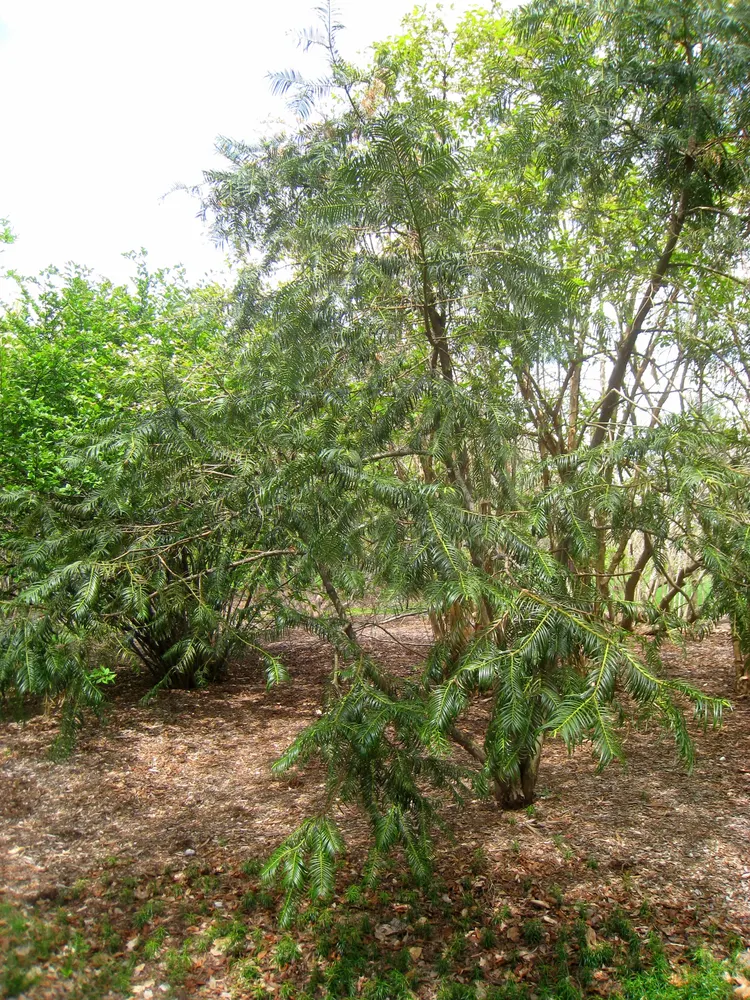
Photo: Daderot, Public domain (via Wikimedia Commons)
Chinese Plum Yew
Cephalotaxus fortunei
Also known as Fortune's Plum Yew, Chinese Cowtail Pine, Sān Jiān Shān (三尖杉, "three-pointed fir")
Key benefits
✦Traditional uses
✦In its native China, Cephalotaxus fortunei has long been valued as a graceful, shade-loving evergreen, often planted near temples and old gardens for its soft, glossy needles and quiet, drooping form. Its timber was traditionally prized by woodworkers for being fine-grained and durable. In the twentieth century the genus gained a very different kind of fame: chemists isolated a family of alkaloids, harringtonine and homoharringtonine among them, from Cephalotaxus bark and foliage, and these compounds went on to become the basis of a modern leukemia medication. That pharmaceutical story belongs to laboratories and licensed physicians, not to home kitchens or tea kettles, and the plant itself has never had a tradition of safe home use.
How to grow & use it
✦The full apothecary for Chinese Plum Yew
Traditional remedies and step-by-step preparations, a complete growing guide, and how to harvest, dry, and store it, all unlocked with HerbLens Unlimited.
- ✦Remedies & preparations
- ✦ Growing guide
- ✦Harvest & storage
From under $6 a month. Free plant identifications always included.
- ✦Japanese maple
- ✦Hosta
- ✦Hellebore
- ✦Cephalotaxus harringtonia (Japanese plum yew), for a similar shade-loving evergreen habit
- ✦Podocarpus macrophyllus, another soft-needled shade conifer
“For the shaded, difficult corner where nothing else will grow, and a deep, glossy green is enough.”
The alkaloid homoharringtonine, first isolated from Cephalotaxus species, was developed into the prescription drug omacetaxine mepesuccinate, approved for treating chronic myeloid leukemia when other treatments fail. A shade shrub grown in Chinese temple gardens for centuries turned out to hold one of modern oncology's more unusual discoveries.
Every part of Cephalotaxus fortunei, especially the seeds and bark, contains cephalotaxine-type alkaloids, including harringtonine and homoharringtonine, which are pharmacologically potent and genuinely toxic if ingested outside of controlled pharmaceutical extraction. These compounds are the basis of a regulated chemotherapy medication used under strict medical supervision, not a home remedy, and there is no safe traditional dose for eating or brewing any part of this plant. Keep it away from children and pets, treat any suspected ingestion as an emergency, and contact a poison control center or physician immediately if it happens. Grow this species for its beauty alone, and speak with a qualified healthcare provider or toxicologist for any concerns rather than attempting any home preparation.