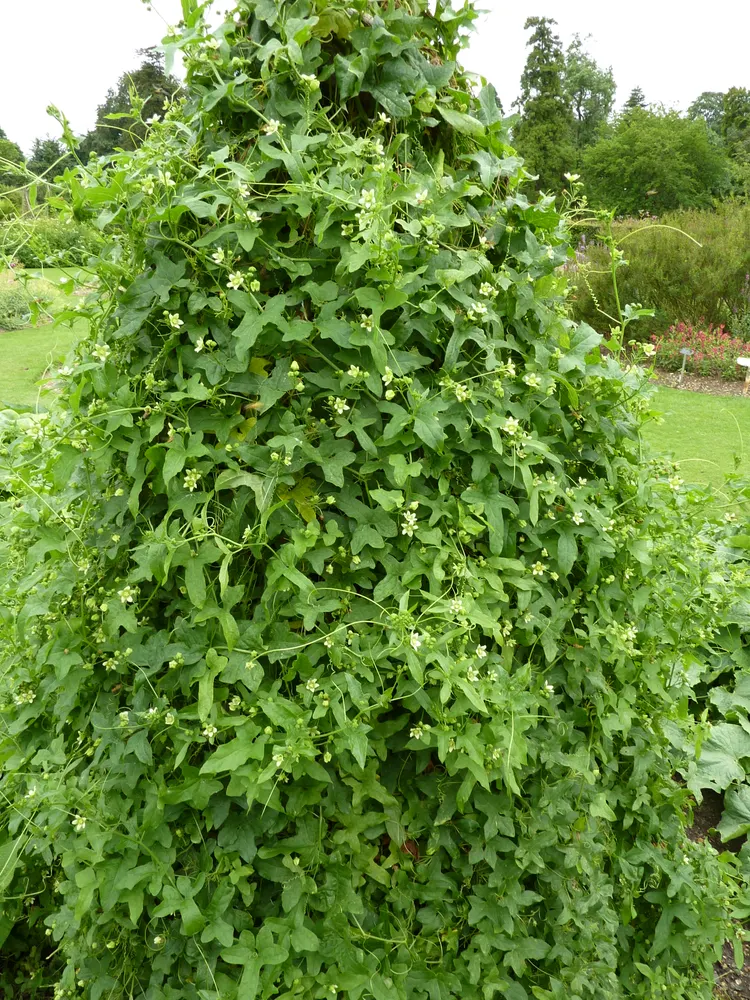
Photo: Magnus Manske, CC BY-SA 3.0 (via Wikimedia Commons)
Red Bryony
Bryonia dioica
Also known as English Mandrake, White Bryony (folk name, though botanically distinct), Devil's Turnip, Wild Vine, Wild Hops
Key benefits
✦Traditional uses
✦Red bryony has one of the more sobering stories in the old herbals. Its swollen, pale taproot can grow astonishingly large and human-shaped, which is exactly why country folk for centuries called it English mandrake and sometimes sold it, dressed up and carved, as a substitute for the far more expensive true mandrake root from the Mediterranean. In traditional European folk practice the root was occasionally grated into a poultice and applied externally to bruises, sprains, and rheumatic joints, and much later it became a well known constituent of homeopathic dilutions, prepared under strict professional control. But herbalists of every era who wrote honestly about this plant also warned against it in the same breath, because the fresh root and the glossy red autumn berries are genuinely poisonous, and the folk memory of red bryony is as much about caution as it is about cure.
How to grow & use it
✦The full apothecary for Red Bryony
Traditional remedies and step-by-step preparations, a complete growing guide, and how to harvest, dry, and store it, all unlocked with HerbLens Unlimited.
- ✦Remedies & preparations
- ✦ Growing guide
- ✦Harvest & storage
From under $6 a month. Free plant identifications always included.
- ✦White bryony, Bryonia alba (a closely related and equally toxic species it is often confused with)
- ✦Black bryony, Tamus communis (unrelated botanically but sharing the common name and the toxic red berries)
- ✦True mandrake, Mandragora officinarum (the plant red bryony's root was historically substituted for)
- ✦Arnica (a safer traditional choice for external bruise care, for topical use only)
- ✦Comfrey (a gentler traditional option for topical soothing of sore joints)
“The plant that teaches you to look, admire, and walk on, not to pick.”
Red bryony's forked, fleshy taproot can grow so large and vaguely humanoid that Elizabethan root-sellers reportedly carved and trained young roots into even more convincing 'little men,' then sold them as the rare and costly true mandrake, a folk deception clever enough that the plant still carries the name English mandrake today.
Red bryony is genuinely poisonous and should never be eaten or self-prepared at home. Every part of the plant contains bitter, irritating compounds, including cucurbitacins and glycosides, with the highest concentrations in the fresh root and the bright red autumn berries. Ingestion can cause severe vomiting, cramping, and diarrhea, and eating even a handful of the tempting red berries has caused serious poisoning, including in children who mistook them for currants; fatalities have been recorded historically. Handling the root or crushed foliage can also irritate the skin. It has no established safe culinary or home-remedy use. Where it appears in modern practice at all, it is exclusively as a highly diluted homeopathic preparation made and dispensed by trained professionals, never as a raw tea, tincture, or poultice made at home. If you are drawn to this plant's history, enjoy it as a hedge-side curiosity to identify and admire, and always talk with a qualified herbalist, physician, or poison control resource before considering any preparation involving Bryonia dioica.