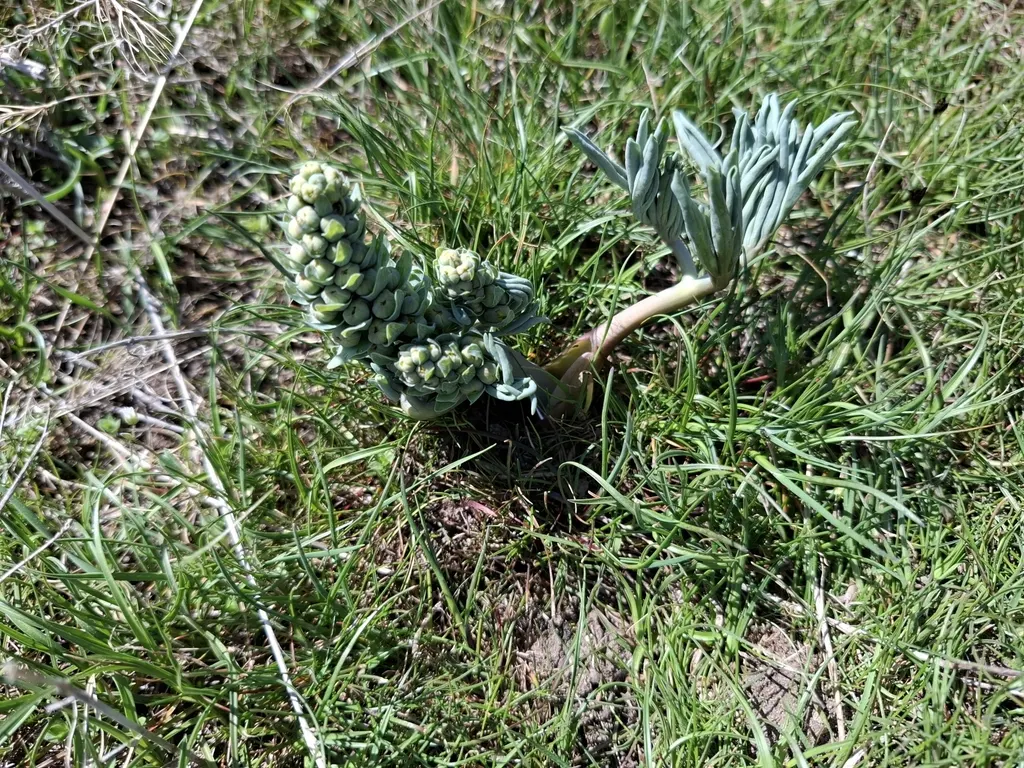
Photo: (c) Margarita, CC BY (via iNaturalist)
Eversmann's Leontice
Leontice ewersmannii
Also known as Eversmann's leontice, yellow lion's leaf
Key benefits
✦Traditional uses
✦Across the arid steppe and rocky foothills of Central Asia, where Leontice ewersmannii pushes up its yellow flowers while snow is still retreating, local healers and herbalists took note of the plant, especially its thick underground tuber. Older Central Asian folk traditions describe the root being dug and prepared for aches, wounds, and other complaints, though doing so safely took real skill, since the tuber, like those of its close relatives in the barberry family, carries potent alkaloids that make careless use dangerous. Modern herbal practice has largely set the plant aside for this reason, and today it survives mainly as a botanical curiosity, a tough, early sign of spring on the steppe rather than something kept in a home apothecary. Its story belongs more to plant exploration and ethnobotany, including that of the naturalist Eduard Eversmann for whom it was named, than to the kitchen or the medicine cabinet.
How to grow & use it
✦The full apothecary for Eversmann's Leontice
Traditional remedies and step-by-step preparations, a complete growing guide, and how to harvest, dry, and store it, all unlocked with HerbLens Unlimited.
- ✦Remedies & preparations
- ✦ Growing guide
- ✦Harvest & storage
From under $6 a month. Free plant identifications always included.
- ✦Steppe tulips (Tulipa species)
- ✦Foxtail lily (Eremurus)
- ✦Gagea, another early steppe bulb
- ✦Yellow crocus (Crocus species), for a similar early gold in the garden
- ✦Winter aconite (Eranthis hyemalis), for an early low-growing yellow bloom
“For the fleeting gold of an early Central Asian spring, best admired on the steppe rather than gathered at home.”
The species name honors Eduard Friedrich Eversmann, a 19th-century German-Russian naturalist who spent years cataloguing the plants and animals of Central Asia. Several other species carry his name too, including Eversmann's redstart, a small migratory bird still spotted across the same steppe country.
Leontice ewersmannii is toxic and should never be ingested or prepared at home. Its tuber contains alkaloids similar to those in blue cohosh, which can cause serious heart and nerve toxicity, so it should be kept away from children and avoided entirely during pregnancy and breastfeeding.