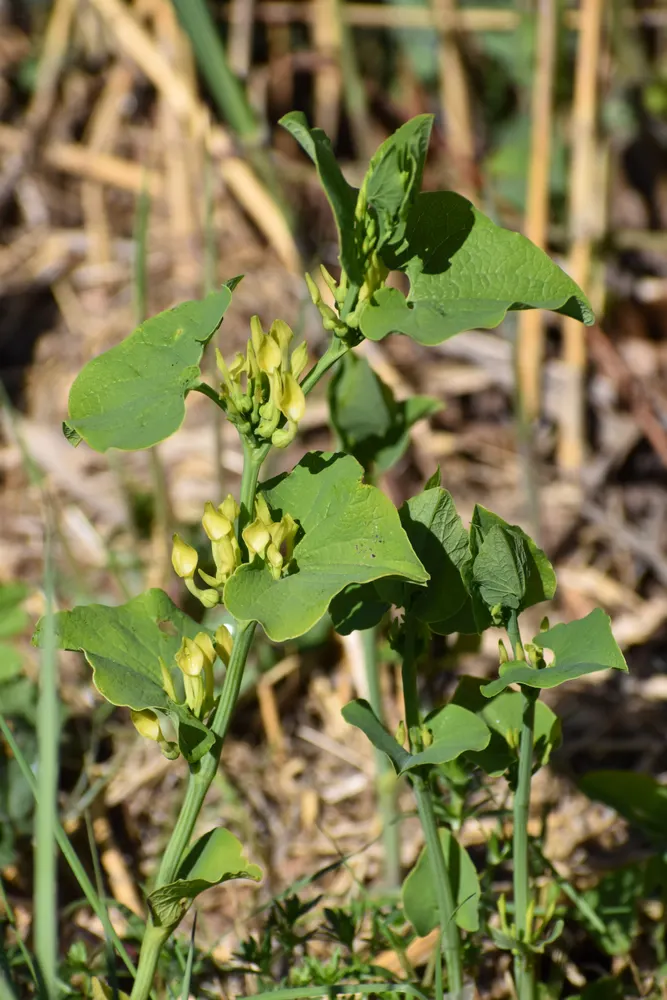
Photo: Tylwyth Eldar, CC BY-SA 4.0 (via Wikimedia Commons)
European Birthwort
Aristolochia clematitis
Also known as Birthwort, Common Birthwort, European Pipevine
Key benefits
✦Traditional uses
✦Birthwort earned its name and its old Latin honorific, aristolochia, roughly "best childbirth," because midwives and physicians across ancient Greece, Rome, and medieval Europe reached for its curved, pipe-shaped flowers and bitter root whenever labor grew difficult. It was tucked into the herbals of Dioscorides and Culpeper alongside remedies for wounds, snakebite, and stubborn fevers, and its odd, twisting blossoms made it a favorite subject for physicians explaining the old "doctrine of signatures," the belief that a plant's shape hinted at its use. That long, trusted history makes its modern story a sobering one: the very compound that made it so reputed, aristolochic acid, turned out to be one of the most dangerous substances found in any traditional plant. Birthwort survives today mostly in old botanical texts, wild hedgerows, and as a lesson in how folklore and safety do not always align.
How to grow & use it
✦The full apothecary for European Birthwort
Traditional remedies and step-by-step preparations, a complete growing guide, and how to harvest, dry, and store it, all unlocked with HerbLens Unlimited.
- ✦Remedies & preparations
- ✦ Growing guide
- ✦Harvest & storage
From under $6 a month. Free plant identifications always included.
- ✦Raspberry leaf (Rubus idaeus), a gentler herb long used to support women through pregnancy and childbirth
- ✦Motherwort (Leonurus cardiaca), traditionally used for women's health support
“A plant for the history books and the botanical garden label, not the teacup.”
In 1992, doctors in Belgium discovered that dozens of women in a weight-loss clinic had developed sudden kidney failure. The cause traced back to Aristolochia accidentally mixed into their herbal supplements, a discovery that opened the door to understanding aristolochic acid as one of the most potent human carcinogens and kidney toxins ever identified in a plant, and led to bans on Aristolochia species in many countries.
Aristolochia clematitis contains aristolochic acid, a compound classified by the International Agency for Research on Cancer as a Group 1 human carcinogen and a potent kidney toxin. Even small or occasional exposure has been linked to aristolochic acid nephropathy, permanent kidney failure, and urinary tract cancers that can appear years after exposure, and there is no dose considered safe. It was historically used to induce labor and expel afterbirth, which means it can also act as an abortifacient and poses serious risk to pregnancy at any stage. Aristolochia species are banned or tightly restricted for human consumption in the United States, the European Union, and many other countries, and health agencies worldwide warn against ingesting them in any form, including teas, tinctures, or supplements. This entry is provided for historical and botanical interest only. Do not grow this plant with the intention of using it, and always consult a qualified healthcare professional before using any herb, especially one with a history like this one.