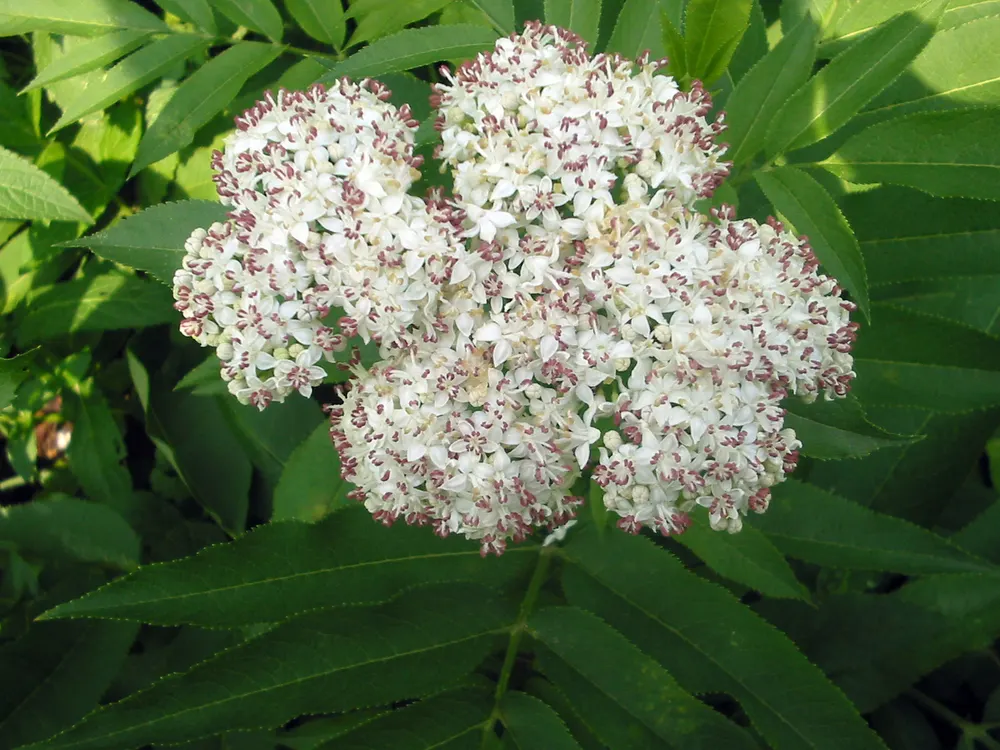
Photo: No machine-readable author provided. Bogdan assumed (based on copyright claims)., CC BY-SA 3.0 (via Wikimedia Commons)
Dwarf Elder
Sambucus ebulus
Also known as Danewort, Walewort, Blood Elder, Deathwort
Key benefits
✦Traditional uses
✦Dwarf elder has long stood in the shadow of its larger, gentler cousin, black elderberry, and old herbals treat it with real caution. European folk healers once turned to its root and leaves as a strong purgative and to ease dropsy and rheumatic swelling, and the crushed foliage was sometimes bound over aching joints. It carries a darker reputation too, tangled up in legends of battlefields and boundary markers, and its old English name, danewort, still echoes that history. Because it is markedly more potent and irritating than Sambucus nigra, herbalists through the centuries treated it as a plant for the hedgerow, not the kitchen.
How to grow & use it
✦The full apothecary for Dwarf Elder
Traditional remedies and step-by-step preparations, a complete growing guide, and how to harvest, dry, and store it, all unlocked with HerbLens Unlimited.
- ✦Remedies & preparations
- ✦ Growing guide
- ✦Harvest & storage
From under $6 a month. Free plant identifications always included.
- ✦Sambucus nigra (black elderberry), the well-documented and traditionally safer elder species
- ✦Meadowsweet, for the joint-easing folk uses once attributed to dwarf elder
“A shadowed, storied cousin of the garden elder, one to recognize and admire rather than pick for the table.”
English folk tradition held that dwarf elder sprang up wherever Danish invaders had been slain in battle, which is how it earned the old name danewort, or 'blood of the Danes.'
Sambucus ebulus is considered toxic and should not be eaten or brewed at home. Every part of the plant, including the leaves, root, bark, and unripe or raw berries, contains cyanogenic glycosides such as sambunigrin, and in dwarf elder these compounds occur in notably higher concentration than in the more familiar black elderberry, Sambucus nigra. Ingestion has been associated with nausea, vomiting, diarrhea, cramping, and dizziness, and the plant is not considered safe for pregnant or breastfeeding people, children, or pets. It should never be substituted for Sambucus nigra in elderberry syrups, teas, or other preparations. If you are drawn to elder for traditional wellness use, speak with a qualified herbalist or healthcare provider and choose a well-documented, correctly identified species instead.