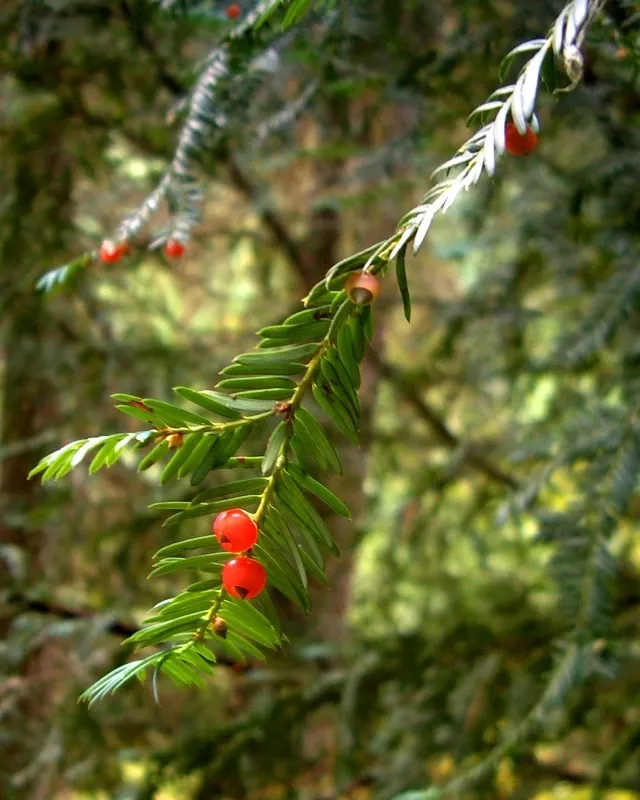
Photo: Jason Hollinger, CC BY 2.0 (via Wikimedia Commons)
Pacific Yew
Taxus brevifolia
Also known as Western Yew, California Yew, Mountain Mahogany (regional, misapplied), Chinwood
Key benefits
✦Traditional uses
✦Long before it entered modern medicine, Pacific yew was treasured by Pacific Northwest peoples, including the Coast Salish, Haida, and Nuu-chah-nulth, for its remarkably dense, springy wood, which was carved into bows, paddles, digging sticks, and tool handles that could outlast almost anything else the forest offered. The tree grew slowly in the shadowed understory of old-growth stands, and a single good bow-stave might represent years of careful selection and seasoning. In the twentieth century, the tree's quiet reputation changed entirely when researchers discovered that compounds in its bark showed powerful activity against cancer cells, a discovery that eventually gave the world the chemotherapy drug paclitaxel. That history is a reminder that this is a tree to admire and study, not one to prepare at home.
How to grow & use it
✦The full apothecary for Pacific Yew
Traditional remedies and step-by-step preparations, a complete growing guide, and how to harvest, dry, and store it, all unlocked with HerbLens Unlimited.
- ✦Remedies & preparations
- ✦ Growing guide
- ✦Harvest & storage
From under $6 a month. Free plant identifications always included.
“A quiet, shadow-loving tree whose secrets reshaped modern medicine, best admired from a respectful distance, never eaten.”
It once took the bark of roughly three to six mature Pacific yews just to produce enough paclitaxel for a single cancer patient's treatment, a cost so steep for these slow-growing old-growth trees that chemists eventually learned to semi-synthesize the drug from a renewable compound in the needles of the related European yew instead.
Pacific yew is genuinely dangerous: its needles, bark, wood, and seeds all contain taxine alkaloids that can cause fatal heart arrhythmias in humans, dogs, horses, and livestock, sometimes after only a small ingested amount, and poisoning can occur with little warning before collapse. The soft red aril surrounding the seed is the one part birds eat, but the seed itself inside is toxic if chewed or crushed, so no part of this tree should ever be eaten, brewed, or prepared at home. The chemotherapy drug derived from yew compounds is produced only through controlled pharmaceutical processes under medical supervision, never through home preparation. Keep children, pets, and grazing animals away from yew clippings and fallen needles, and always consult a qualified healthcare professional or physician for anything related to yew-derived medicines or suspected exposure.