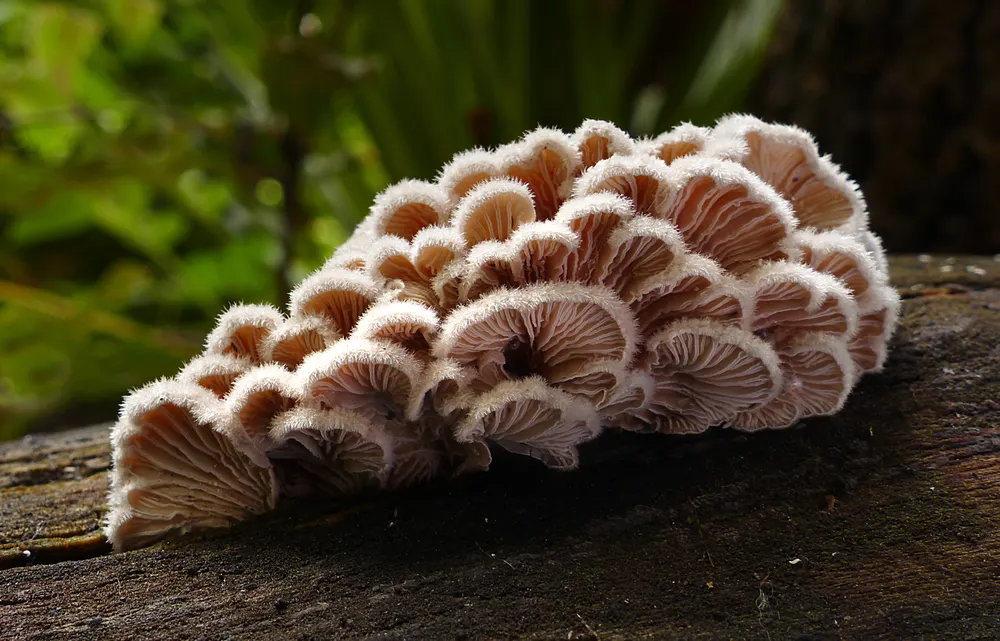
Photo: Bernard Spragg. NZ from Christchurch, New Zealand, CC0 (via Wikimedia Commons)
Split Gill Mushroom
Schizophyllum commune
Also known as Split gill, Splitgill mushroom, Common split gill, Gray split gill
Key benefits
✦Traditional uses
✦Schizophyllum commune is one of the most widely distributed mushrooms on Earth, turning up on fallen branches and dead wood on nearly every continent. Its small, fan-shaped, velvety gray caps have long been gathered as food in parts of Mexico, West Africa, and Northeast India, where the tough little mushroom is simmered into soups and stews until it softens. In Japan, a polysaccharide isolated from its fruiting body, called schizophyllan, was developed into a licensed pharmaceutical used alongside conventional cancer treatment to support the immune system, a modern echo of the mushroom's older folk reputation as a strengthening food. Because it dries to a papery husk and springs back to life the moment rain returns, it has also earned a quiet place in folk memory as a small emblem of endurance.
How to grow & use it
✦The full apothecary for Split Gill Mushroom
Traditional remedies and step-by-step preparations, a complete growing guide, and how to harvest, dry, and store it, all unlocked with HerbLens Unlimited.
- ✦Remedies & preparations
- ✦ Growing guide
- ✦Harvest & storage
From under $6 a month. Free plant identifications always included.
- ✦Ginger
- ✦Garlic
- ✦Lemongrass
- ✦Wood ear mushroom (Auricularia)
- ✦Shiitake mushroom
“For the forager drawn to the small gray survivor that dries to leather in the sun and springs back to life with the next rain.”
Schizophyllum commune holds a record almost no other living thing can claim: mycologists have identified more than 23,000 distinct mating types within the species, making it one of the most complex reproductive systems known in nature.
Split gill mushroom is eaten as food in parts of Mexico, West Africa, and Northeast India, but it's tough and fibrous and must be cooked thoroughly. People who are immunocompromised or have chronic lung conditions should avoid handling or foraging it, since it has rarely been linked to opportunistic lung and sinus infections.