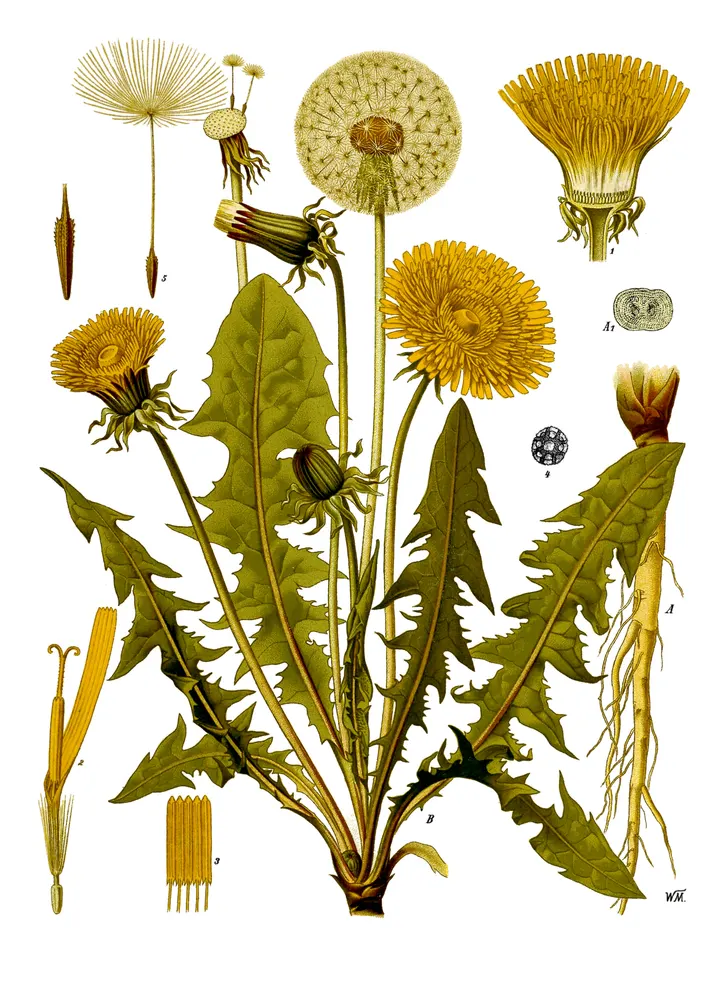
Photo: Walther Otto Müller, Public domain (via Wikimedia Commons)
Dandelion
Taraxacum officinale
Also known as Lion's Tooth, Blowball
Key benefits
✦Traditional uses
✦Dismissed by many as a lawn weed, dandelion is quietly one of the most complete medicinal plants in any garden. It has been used across European, Chinese, and Native American traditions for centuries for liver support, urinary health, and as a nourishing spring tonic. Every part earns its place: the bitter root stirs bile production, the leaves carry more nutrition per gram than spinach, and the sunny flowers hold antioxidant flavonoids.
How to grow & use it
✦The full apothecary for Dandelion
Traditional remedies and step-by-step preparations, a complete growing guide, and how to harvest, dry, and store it, all unlocked with HerbLens Unlimited.
- ✦Remedies & preparations
- ✦ Growing guide
- ✦Harvest & storage
From under $6 a month. Free plant identifications always included.
- ✦Burdock
- ✦Milk Thistle
- ✦Nettle
- ✦Chicory root
- ✦Burdock
“When the liver feels sluggish or digestion needs a bitter nudge.”
During the Second World War, dandelion roots were roasted as a coffee substitute across Europe when real coffee was impossible to find.
Dandelion is generally very safe as a food and tea. Avoid it if you're allergic to the daisy (Asteraceae) family, and use caution if you have gallbladder problems or take diuretic or blood-thinning medication.