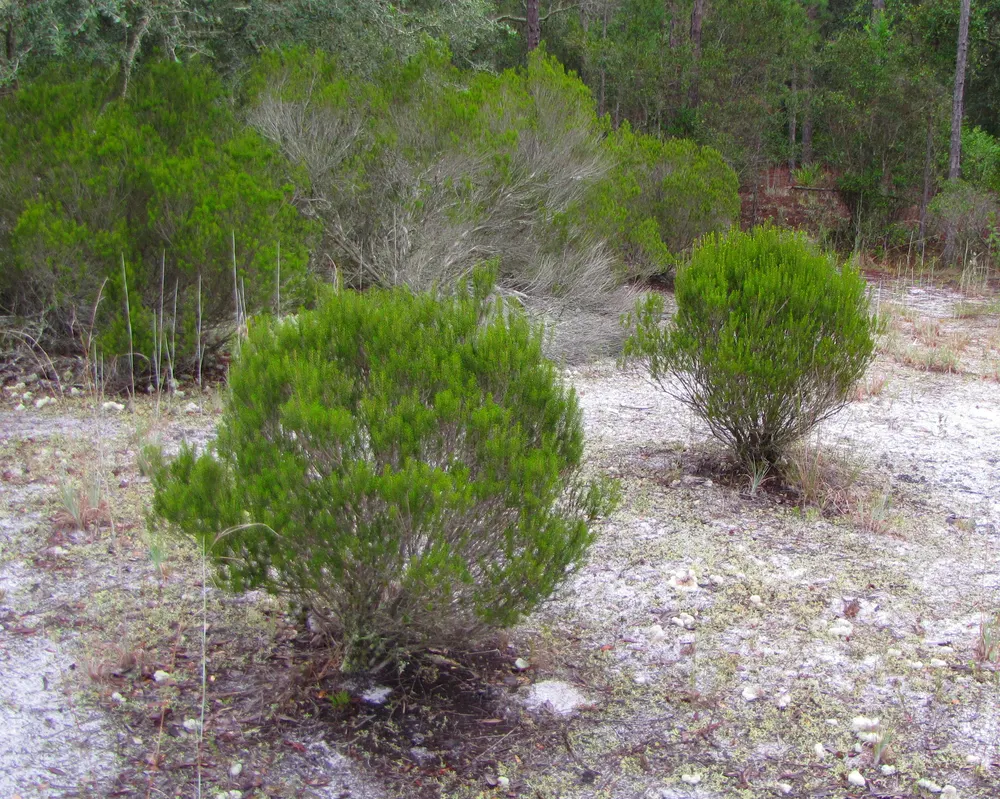
Photo: Riverbanks Outdoor Store from New Port Richey, FL, United States, CC BY 2.0 (via Wikimedia Commons)
Florida Rosemary
Ceratiola ericoides
Also known as Sandheath, Rosemary Scrub, Sand-heath, Wild Rosemary (Florida)
Key benefits
✦Traditional uses
✦Florida rosemary is one of the oldest, most distinctive shrubs of the Florida scrub, a relict plant community that botanists believe has persisted, largely unchanged, since ancient shoreline eras when much of the peninsula lay underwater. Its needle-thin, aromatic foliage recalls the culinary herb rosemary closely enough to have borrowed its name, but the two plants are not related, and Florida rosemary has no history of use in cooking or herbal medicine. For scrub naturalists and early Florida settlers, it served a different kind of purpose, its silvery presence a dependable sign of deep, well-drained sand and of the gopher tortoises and scrub-jays that depend on that same ground. Rather than earning a place in the medicine chest, this plant earned its keep as a quiet architect of the scrub itself, shaping the open, sandy patches that give the whole community its distinctive, wind-swept character.
How to grow & use it
✦The full apothecary for Florida Rosemary
Traditional remedies and step-by-step preparations, a complete growing guide, and how to harvest, dry, and store it, all unlocked with HerbLens Unlimited.
- ✦Remedies & preparations
- ✦ Growing guide
- ✦Harvest & storage
From under $6 a month. Free plant identifications always included.
- ✦Sand pine
- ✦Scrub palmetto
- ✦Garberia
- ✦Rosmarinus officinalis (true rosemary, for culinary or aromatic use)
- ✦Conradina canescens (false rosemary, a fragrant, edible-garden-friendly look-alike)
“For the gardener who wants a living fragment of ancient Florida scrub standing silver and sun-hardened in the sand.”
Florida rosemary is allelopathic: its needles and roots release natural chemical compounds that suppress other seeds from sprouting nearby, which is why botanists often find a bare, sandy halo of open ground encircling each shrub in the scrub.
This plant has no history of use as food or medicine and should not be eaten; its foliage contains compounds that suppress competing plants and have not been shown safe to ingest. It is unrelated to culinary rosemary despite the shared name.