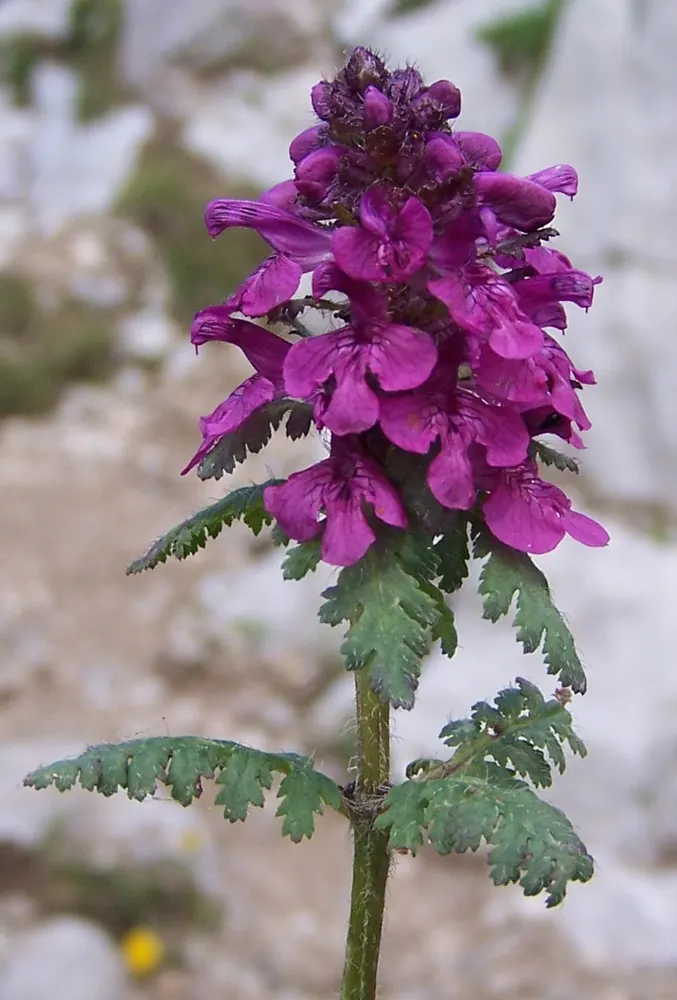
Photo: Jerzy Opioła, CC BY-SA 3.0 (via Wikimedia Commons)
Whorled Lousewort
Pedicularis verticillata
Also known as Verticillate Lousewort
Traditional uses
✦Whorled Lousewort belongs to a genus with a colorful, if entirely unearned, reputation. For generations, herders across the mountains of Europe and Asia blamed Pedicularis plants for lice outbreaks among grazing livestock, which is how the whole lousewort family got its common English name, though the plants themselves had nothing to do with it. Unlike a few of its cousins, such as wood betony, which earned a real place in traditional herbal cabinets, Whorled Lousewort has left almost no mark on the historical medicinal record, likely because it grows only in remote, high, cold ground far from most herbal traditions. Its true legacy lives in alpine ecology instead, as one of the small, tenacious wildflowers that mountain travelers and botanists have long used as a marker of healthy, undisturbed high-elevation meadow.
How to grow & use it
✦The full apothecary for Whorled Lousewort
Traditional remedies and step-by-step preparations, a complete growing guide, and how to harvest, dry, and store it, all unlocked with HerbLens Unlimited.
- ✦Remedies & preparations
- ✦ Growing guide
- ✦Harvest & storage
From under $6 a month. Free plant identifications always included.
“Choose this one for the thrill of spotting it on a high mountain trail, not for the teapot.”
The genus name Pedicularis comes from the Latin pediculus, meaning louse. Old-time herders across Europe noticed sheep and cattle grazing near these plants sometimes came down with lice, and rather than blame poor pasture hygiene, they blamed the wildflower, a superstition that stuck hard enough to name an entire genus. The species name verticillata simply describes the plant's most charming feature, the way its leaves circle the stem in tidy whorls.
Whorled Lousewort has no established history of internal, medicinal, or culinary use in Western or folk herbalism, so there are no traditional doses to reference here. It is a hemiparasitic plant, meaning it draws part of its water and nutrients directly from the roots of neighboring alpine plants, and the chemical makeup of any one specimen can shift unpredictably depending on which host it has tapped into. For that reason alone, it should not be eaten, brewed, or otherwise taken internally. Pregnant and nursing people should avoid it entirely, as there is no safety data of any kind. Many alpine and tundra habitats where it grows are also ecologically sensitive or protected, so it is worth checking local rules before disturbing any part of the plant. As always, speak with a qualified herbalist, botanist, or medical professional before considering any wild, undocumented plant for internal use.