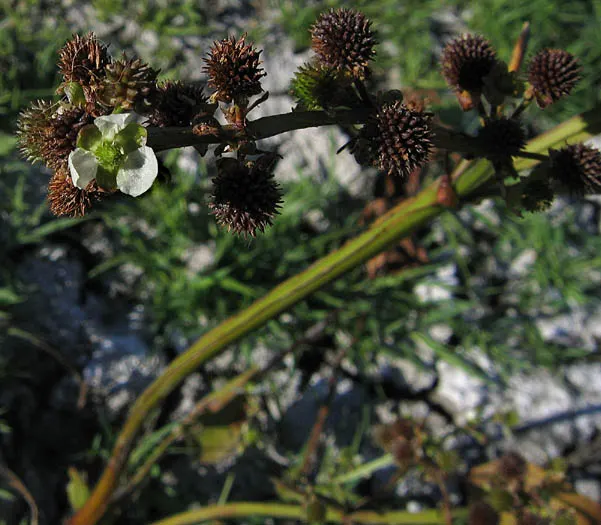
Photo: Anthony Valois and the National Park Service, Public domain (via Wikimedia Commons)
Cellophane Plant
Echinodorus berteroi
Also known as Upright Burhead, Cellophane Sword, Chihuahua Amazon Sword
Key benefits
✦Traditional uses
✦Echinodorus berteroi has always belonged more to the water garden than the medicine chest. Long before it found its way into home aquariums, it grew quietly at the soft margins of ponds and ditches from Texas down through Mexico and into South America, part of the tangle of wetland plants that fish, frogs, and wading birds relied on for cover. Aquascapers eventually took notice of its crinkled, almost see-through leaves and began cultivating it deliberately, giving it the common name cellophane plant. Its story is really one of quiet ecological usefulness rather than herbal tradition, valued for the shelter and clean water it helps provide rather than for any remedy drawn from its leaves.
How to grow & use it
✦The full apothecary for Cellophane Plant
Traditional remedies and step-by-step preparations, a complete growing guide, and how to harvest, dry, and store it, all unlocked with HerbLens Unlimited.
- ✦Remedies & preparations
- ✦ Growing guide
- ✦Harvest & storage
From under $6 a month. Free plant identifications always included.
- ✦Sagittaria (arrowhead)
- ✦Vallisneria (eelgrass)
- ✦Water lettuce
- ✦Echinodorus cordifolius (radicans sword)
- ✦Sagittaria subulata
“For the quiet green heart of a pond or tank, where clear water and sheltering leaves matter more than any remedy.”
The plant earned its common name because its leaves, when grown underwater, are so thin and crinkled they look and rustle almost like real cellophane, a texture that vanishes once the leaves grow up into the air.
Cellophane plant has no history as a food or medicinal herb and isn't eaten or brewed; it's grown as a pond and aquarium plant. As an aquatic plant it takes up whatever is in its water, so be mindful of water quality if handling it.