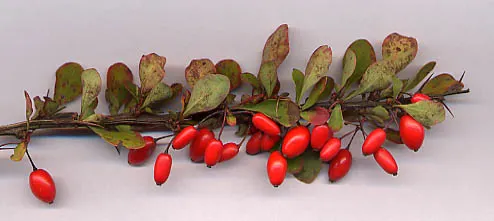
Photo: User:MPF, CC BY-SA 3.0 (via Wikimedia Commons)
Japanese Barberry
Berberis thunbergii
Also known as Thunberg's Barberry, Red Barberry
Key benefits
✦Traditional uses
✦Japanese barberry was carried out of Japan in the 1870s as a tidy, thorny substitute for its European cousin, common barberry, after farmers began pulling that plant out for harboring wheat rust. It was never really a folk medicine plant in its own right, its fame was always in the hedgerow, prized for its fiery autumn color and its knack for turning back deer and trespassers alike. That said, it belongs to the same berberine-rich genus as barberries that herbalists have leaned on for centuries, so its chemistry is often mentioned in the same breath as its more medicinally storied relatives, even though this particular species was not traditionally gathered for the home apothecary. Today it is better known to land managers as an aggressive invader than to herbalists as a remedy.
How to grow & use it
✦The full apothecary for Japanese Barberry
Traditional remedies and step-by-step preparations, a complete growing guide, and how to harvest, dry, and store it, all unlocked with HerbLens Unlimited.
- ✦Remedies & preparations
- ✦ Growing guide
- ✦Harvest & storage
From under $6 a month. Free plant identifications always included.
- ✦Oregon grape (Mahonia aquifolium)
- ✦Goldenseal (Hydrastis canadensis)
- ✦Barberry (Berberis vulgaris)
- ✦Common barberry (Berberis vulgaris), the traditionally documented medicinal relative
- ✦Oregon grape root (Mahonia aquifolium)
“For a hedge that blazes scarlet every autumn and turns away every trespasser, this is the shrub, just plant it thoughtfully, since it rarely stays where it is put.”
Ecologists have found that thickets of Japanese barberry hold more humidity at ground level than the surrounding woods, and that damp microclimate turns out to be ideal for blacklegged ticks, so dense stands of this pretty shrub have been linked to higher local rates of Lyme disease.
Japanese barberry isn't used medicinally, and its thorny stems call for gloves when handling. It's classified as an invasive species across much of the eastern and midwestern US, and many states restrict planting or selling it.