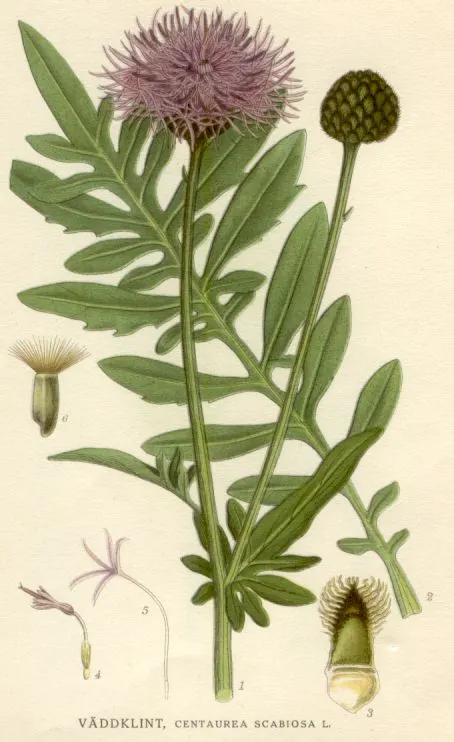
Photo: Carl Axel Magnus Lindman, Public domain (via Wikimedia Commons)
Greater Knapweed
Centaurea scabiosa
Also known as Hardheads, Knobweed, Churls Head, Greater Centaury
Key benefits
✦Traditional uses
✦Long before it was tidied into flower beds, greater knapweed grew wild across the chalky meadows of Europe, where country folk came to know it as a steady, astringent friend for the skin. Its bruised leaves and flowers were traditionally pressed onto cuts, bruises, and stubborn sores, and a cooled infusion was gargled for sore throats or dabbed onto irritated skin. Herbalists of earlier centuries also turned to the root for swollen glands, which is likely how the plant earned its old reputation as a remedy for what was then called scrofula. Through it all, its shaggy purple blooms have done double duty as one of the finest nectar plants a meadow can offer, drawing bees, butterflies, and burnet moths from midsummer to first frost.
How to grow & use it
✦The full apothecary for Greater Knapweed
Traditional remedies and step-by-step preparations, a complete growing guide, and how to harvest, dry, and store it, all unlocked with HerbLens Unlimited.
- ✦Remedies & preparations
- ✦ Growing guide
- ✦Harvest & storage
From under $6 a month. Free plant identifications always included.
- ✦Plantain
- ✦Yarrow
- ✦Calendula
- ✦Yarrow
- ✦Self-heal (Prunella vulgaris)
“When you want a tough, honest meadow plant that has quietly patched up skin and throats for centuries, and fed every bee in the parish while doing it.”
Old herbalists once grouped knapweeds with the true scabious plants because their shaggy, thistle-like flower heads look so alike, and both were reached for when someone had a scabby or irritated patch of skin. The resemblance stuck so firmly that the species name scabiosa survives on the plant to this day, even though botanists have since sorted the two families apart.
Greater knapweed has no significant record of toxicity, though as a daisy-family plant it may cause allergic reactions in people sensitive to ragweed or related plants.