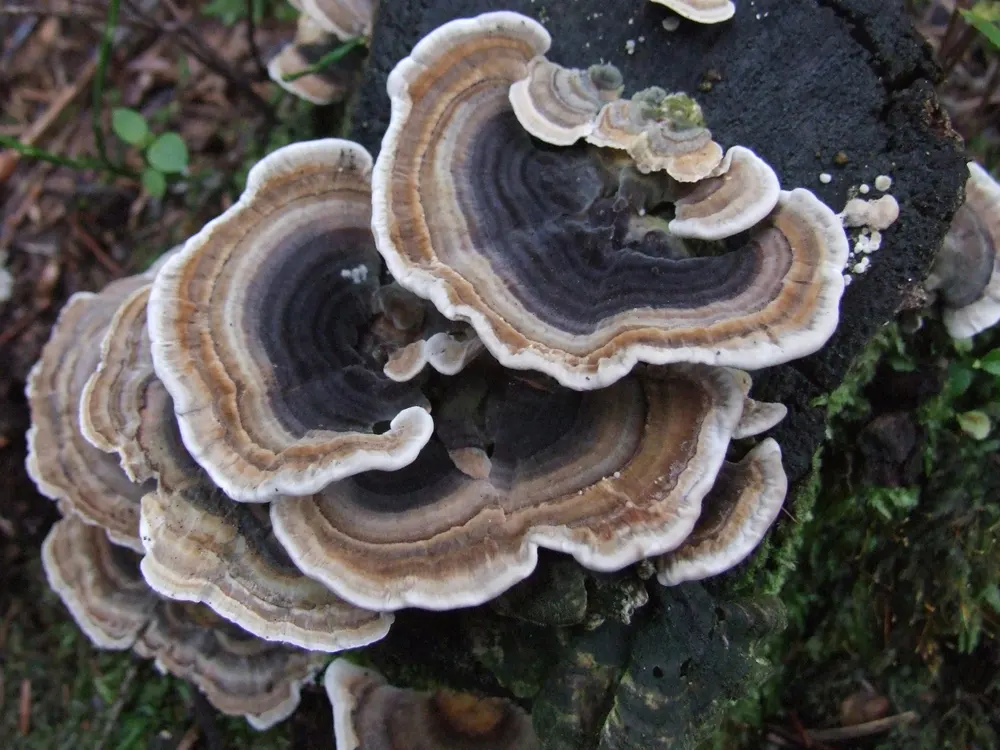
Photo: Jerzy Opioła, CC BY-SA 3.0 (via Wikimedia Commons)
Turkey Tail
Trametes versicolor
Also known as Yun Zhi, Kawaratake, Cloud Mushroom, Coriolus versicolor
Key benefits
✦Traditional uses
✦Turkey tail has been simmered into teas, broths, and tonics across East Asian herbal traditions for centuries, known as yun zhi in China and kawaratake in Japan, where it was valued as a gentle, everyday support for vitality and resilience. Foragers have long recognized its fan-shaped, concentric-banded brackets fanned like feathers across fallen logs, and it became one of the first wild mushrooms Western science turned to study for its polysaccharide content. Because it grows so abundantly and is so readily identified, it has endured as one of the most accessible tonic mushrooms available to home foragers and herbalists, requiring no garden bed at all, only a walk into the woods after rain.
How to grow & use it
✦The full apothecary for Turkey Tail
Traditional remedies and step-by-step preparations, a complete growing guide, and how to harvest, dry, and store it, all unlocked with HerbLens Unlimited.
- ✦Remedies & preparations
- ✦ Growing guide
- ✦Harvest & storage
From under $6 a month. Free plant identifications always included.
- ✦Reishi
- ✦Astragalus
- ✦Ginger
- ✦Reishi
- ✦Maitake
“For the walk in the woods when a fan of color catches your eye on a fallen log, and you want to carry an old forest tonic home in your basket.”
The name versicolor, meaning many-colored, comes from the way each individual bracket grows in concentric bands of brown, tan, rust, and blue-gray, a pattern foragers say mirrors the fanned tail feathers of a wild turkey.
This immune-active mushroom is generally well tolerated but may not be suitable for those with autoimmune conditions or on immunosuppressant medication. Confirm identification when foraging, since bracket fungi have tougher lookalikes.