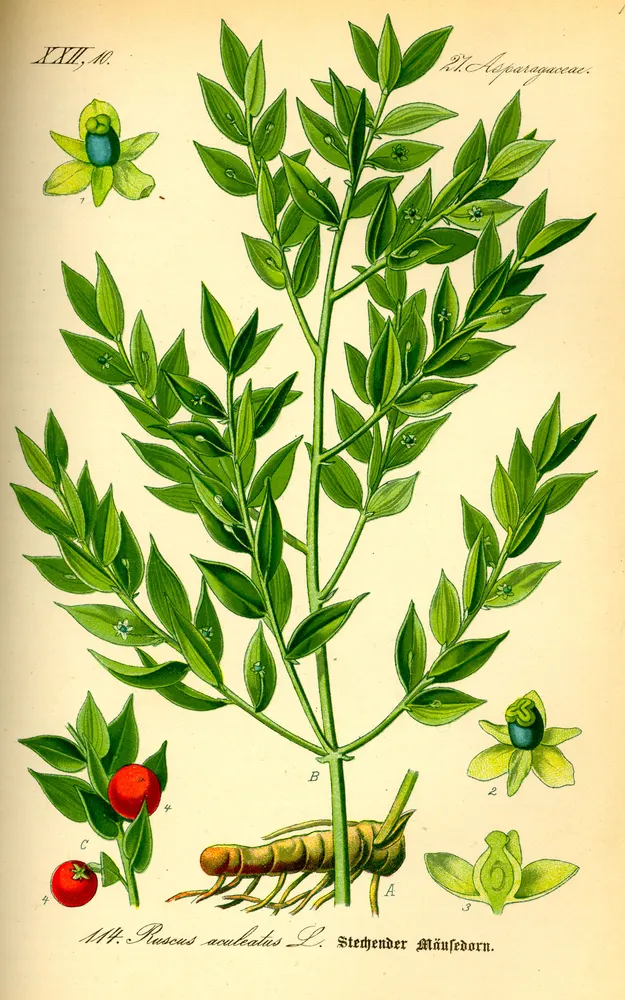
Photo: Public domain (via Wikimedia Commons)
Butcher's Broom
Ruscus aculeatus
Also known as Box Holly, Knee Holly, Sweet Broom, Jew's Myrtle, Pettigree
Key benefits
✦Traditional uses
✦Butcher's broom takes its curious name from an old kitchen habit, butchers once bundled its stiff, spiny stems into brooms to scrub their chopping blocks clean and to keep mice away from hanging meat. Long before that practical use, ancient Greek and Roman physicians, including Dioscorides, recorded the root as a remedy for swelling, kidney complaints, and sluggish circulation. By the medieval period it had become a staple of European herbalism for tired, heavy legs, and that reputation carried it into modern herbal medicine, where the root is still one of the most studied traditional plants for venous and hemorrhoidal support. Its rise from a rough-and-ready cleaning tool to a respected circulatory herb is one of the more charming stories in the apothecary garden.
How to grow & use it
✦The full apothecary for Butcher's Broom
Traditional remedies and step-by-step preparations, a complete growing guide, and how to harvest, dry, and store it, all unlocked with HerbLens Unlimited.
- ✦Remedies & preparations
- ✦ Growing guide
- ✦Harvest & storage
From under $6 a month. Free plant identifications always included.
- ✦Horse Chestnut
- ✦Gotu Kola
- ✦Witch Hazel
- ✦Horse Chestnut
- ✦Gotu Kola
“When your legs feel heavy and tired at the end of a long day, and you find yourself thinking of the old root the herbalists turned to.”
The plant's odd 'leaves' are not true leaves at all but flattened stem tissue called cladodes, and if you look closely, tiny flowers and later berries appear to sprout directly from the middle of each spiny blade, a botanical sleight of hand few other plants pull off.
Butcher's broom may raise blood pressure and can interact with MAOI antidepressants and blood pressure medications. Only the root is used traditionally, since the bright red berries are mildly toxic, and it is best avoided during pregnancy and breastfeeding.